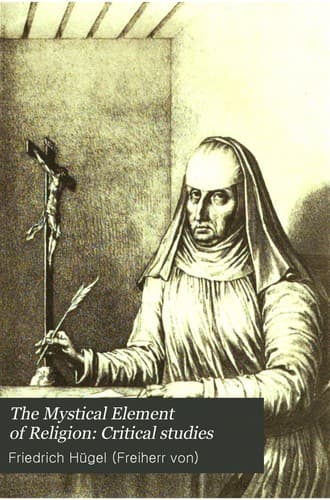
The Mystical Element of Religion, as studied in Saint Catherine of Genoa and her friends, Volume 2 (of 2)Hügel, Friedrich, Freiherr von
Religion
The Mystical Element of Religion, as studied in Saint Catherine of Genoa and her friends, Volume 2 (of 2)
Hügel, Friedrich, Freiherr von
Catherine, of Genoa, Saint, 1447-1510
(4) Yet these two differences have largely sprung from the simple
pressing and further extension of precisely the least satisfactory, the
explanatory and systematic side,--the form as against the content,--of
the older Mystics. For once the more specifically Neo-Platonist
constituent, in those Mystics’ explanation and systematization, was
isolated from the elements of other provenance which there had kept it
in check, and now became, as it were, hypostasized and self-sufficient,
this constituent could not but reveal, more clearly than before, its
inadequacy as a form for the intensely organic and “incarnational”
spiritual realities and processes which it attempted to show forth.
That Neo-Platonist constituent, always present in those ancient
Mystics, had ever tended to conceive the soul’s unity, at any one
moment, as a something outside of all multiplicity whatsoever. Hence
this character of the simultaneous unity had only to be extended to
the successive unity,--and the literally One Act, as in the present so
throughout the future, became a necessary postulate.
And that same constituent had, even in those great teachers of
profound maxims, exquisite religious psychology, and noblest living,
tended, (however efficaciously checked by all this their Christian
experience and by certain specifically Platonist and Aristotelian
elements of their philosophy), towards depreciating the necessity,
importance, indeed even the preponderant utility, of the External,
Contingent, Historical and Institutional, and of the interchange, the
inter-stimulation between these sides and expressions of religion and
its internal centre and spirit.
Perhaps, amongst all the great ecclesiastically authorized Mystics of
that past, the then most recent of them all, St. John of the Cross,
comes, by his (theoretically continuous though in his practice by no
means exclusive) insistence upon the abstractive and universal, the
obscure and invisible, the self-despoiling and simplifying element and
movement, nearest to an exclusion of the other element and movement.
Indeed the Quietists’ generally strong insistence upon the necessity
of a Director and upon Frequent Communion gives their teaching, when
taken in its completeness, a prima facie greater Institutionalism than
is offered by the spiritual theory of the great Spaniard. Yet if, even
in him, one misses, in his theoretical system, a sufficiently organic
necessity for the outgoing movement, a movement begun by God Himself,
and which cannot but be of fundamental importance and influence for
believers in the Incarnation, there is as complete an absence of the
doctrinaire One-Act recipe for perfection as in the most Historical and
Institutional of Christian teachers. But more about this hereafter.
6. _Four needs recognised by Quietism._
Public-domain text, read in full here on John Shaqi.
Reviews
Reviews
No reviews yet
Be the first to share your thoughts on this work.
Elsewhere in the archive
Join the Discussion
Join the discussion
Sign in to leave a comment or review.
Sign InorCreate an account