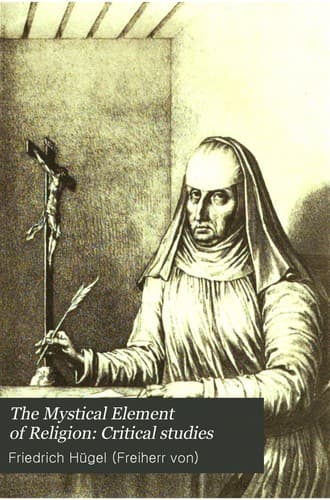
The Mystical Element of Religion, as studied in Saint Catherine of Genoa and her friends, Volume 2 (of 2)Hügel, Friedrich, Freiherr von
Religion
The Mystical Element of Religion, as studied in Saint Catherine of Genoa and her friends, Volume 2 (of 2)
Hügel, Friedrich, Freiherr von
Catherine, of Genoa, Saint, 1447-1510
other extreme, of making this inarticulateness and wise indirectness
of striving into the one test and measure of the perfection of all
the constituents of the religious life, instead of insisting upon
various degrees and combination of full and direct consciousness and
articulation, and of much dimness and indirect alertness, as each
requiring the other, and as both required by the complete and normal
life of the soul.
(4) And Man has a deep-seated sense of shame, in precise proportion
as he becomes spiritually awake, about appropriating to himself his
virtues and spiritual insight, even in so much as he perceives and
admits his possession of them. Not all his consciousness and conviction
of the reality of his own efforts and initiative, can or does prevent
a growing sense that this very giving of his is (in a true sense)
God’s gift,--that his very seeking of God ever implies that he had, in
some degree, already found God,--that God had already sought him out,
in order that he might seek and find God.--No wonder then that, once
more shrinking from a Unity constituted in a Multiplicity, Quietism
should, (with the apparently sole choice before it, of God Himself
operating literally all, or of man subtracting something from that
exclusive action and honour of God), have chosen God alone and entire,
rather than, as it were, a fragmentary, limited, baffled influence
and efficiency of the Almighty within His Own creature. Yet here
again the greater does not supplant, but informs, the lesser; and the
Incarnational action of God is, in this supreme question also, the
central truth and secret of Christianity.
7. _Multiplicity and unity, in different proportions, needful for all
spiritual life._
We find, then, that it is essential for even the most advanced souls,
that they should keep and increase the sense and the practice of a
right multiplicity, as ever a constituent and essential condition
of every concrete, living unity; of a right attachment, as ever the
necessary material and content for a fruitful and enriching detachment;
of a right consciousness and articulation of images, thoughts,
feelings, volitions, and external acts, as ever stimulations, restful
alternations, and food for a wise and strengthening prayer or states
of Quiet and inarticulation; and of a right personal initiative
and responsibility, as the most precious means and element for the
operations of God.
Public-domain text, read in full here on John Shaqi.
Reviews
Reviews
No reviews yet
Be the first to share your thoughts on this work.
Elsewhere in the archive
Join the Discussion
Join the discussion
Sign in to leave a comment or review.
Sign InorCreate an account