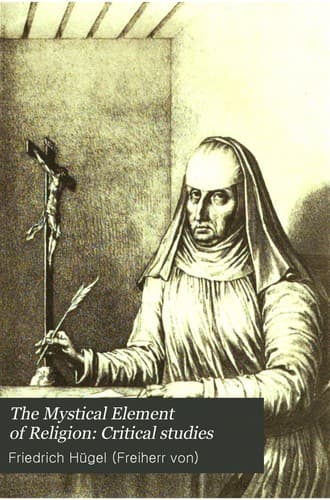
The Mystical Element of Religion, as studied in Saint Catherine of Genoa and her friends, Volume 2 (of 2)Hügel, Friedrich, Freiherr von
Religion
The Mystical Element of Religion, as studied in Saint Catherine of Genoa and her friends, Volume 2 (of 2)
Hügel, Friedrich, Freiherr von
Catherine, of Genoa, Saint, 1447-1510
We find, too, that it is equally important, for even the most imperfect
souls, to be helped towards some, (though but ever semi-conscious and
intermittent), sense of the unity which alone can give much worth
or meaning to their multiplicity; of the detachment which alone can
purify and spiritualize their attachments; of the self-oblivion, in
rapt and peaceful admiration, which alone can save even their right
self-watchings and self-improvements from still further centring them
in themselves; and of the true self-abandonment to pure grace and the
breathing of God’s Spirit, which alone can give a touch of winning
freedom and of joyful spaciousness to all the prudence and right fear
and conscious responsibility which, left alone, will hip, darken and
weigh down the religious soul.
And thus we shall find that there is no degree of perfection for any
one set of souls which is not, in some form and amount, prefigured and
required by all other souls of good-will; and again, that there is
no one constituent, to which any one soul is specially drawn, which
does not require the supplementation and corrective of some other
constituents, more fully represented in other souls of possibly lower
sanctity.
Thus each soul and grade requires all the others; and thus the measure
of a soul’s greatness is not its possessing things which cannot, in
any degree or way, be found in, or expected of, all human souls, in
proportion as they are fully and characteristically human, but, on the
contrary, its being full of a spirit and a force which, in different
degrees and forms, are the very salt and yeast, the very light and
life, of all men in every place and time.
The following weighty declaration, long ascribed to St. Thomas Aquinas,
fully covers, I think, the doctrine and ideal aimed at throughout this
section: “Already in this life we ought continuously to enjoy God, as
a thing most fully our own, in all our works.… Great is the blindness
and exceeding the folly of many souls that are ever seeking God,
continuously sighing after God, and frequently desiring God: whilst,
all the time, they are themselves the tabernacles of the living God …
since their soul is the seat of God, in which He continuously reposes.
Now who but a fool deliberately seeks a tool which he possesses under
lock and key? or who can use and profit by an instrument which he is
seeking? or who can draw comfort from food for which he hungers, but
which he does not relish at leisure? Like unto all this is the life
of many a just soul, which ever seeks God and never tarries to enjoy
Him; and all the works of such an one are, on this account, less
perfect.”[138]
IV. PURE LOVE, OR DISINTERESTED RELIGION: ITS DISTINCTION FROM QUIETISM.
Public-domain text, read in full here on John Shaqi.
Reviews
Reviews
No reviews yet
Be the first to share your thoughts on this work.
Elsewhere in the archive
Join the Discussion
Join the discussion
Sign in to leave a comment or review.
Sign InorCreate an account