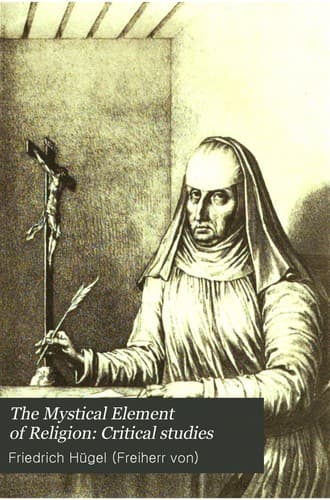
The Mystical Element of Religion, as studied in Saint Catherine of Genoa and her friends, Volume 2 (of 2)Hügel, Friedrich, Freiherr von
Religion
The Mystical Element of Religion, as studied in Saint Catherine of Genoa and her friends, Volume 2 (of 2)
Hügel, Friedrich, Freiherr von
Catherine, of Genoa, Saint, 1447-1510
And, says St. Thomas, such Perfect Love alone is Love in its strict
sense and “the most excellent of all the virtues”: for “ever that which
exists for its own sake is greater than that which exists in view of
something else. Now Faith and Hope attain indeed to God, yet as the
source from which there accrue to us the knowledge of the Truth and
the acquisition of the Good; whilst Love attains to God Himself, with
a view to abide in Him, and not that some advantage may accrue to us
from Him.” And perhaps still more clearly: “ When a man loves something
so as to covet it, he apprehends it as something pertaining to his
own well-being. The lover here stands towards the object beloved, as
towards something which is his property.”[165] And note how, although
he teaches that whereas “the beatitude of man, as regards its cause
and its object, is something increate,” _i.e._ God Himself, “the
essence of the beatitude itself is something created,” for “men are
rendered blessed by participation, and this participation in beatitude
is something created”: yet he is careful to explain some of his more
incidental passages, in which he speaks of this essence of beatitude
as itself man’s end, by the _ex professo_ declaration: “God” alone “is
man’s ultimate end, and beatitude is only as it were an end before the
very end, an end in immediate proximity to the ultimate end.”[166]
(2) And next, as to the possibility, actual occurrence and
desirableness of single Acts of such Pure Love, even here below:
all this is assumed as a matter of course throughout St. Thomas’s
_ex professo_ teaching on the matter. For throughout the passages
concerning the Nature of Pure Love he is not exclusively, indeed not
even primarily, busy with man’s acts in the future life, but with the
respective characteristics of man’s various acts as executed and as
analyzable, more or less perfectly, already here below. And nowhere
does he warn us against concluding, from his reiterated insistence upon
the essential characteristics of Pure Love, that such love cannot, as
a matter of fact, be practised, at least in single acts, here below at
all. Hence it is clear that, according to him, the soul as it advances
in perfection will--alongside of acts of supernatural Faith, Hope,
Fear, etc. (and the production of such acts will never cease), produce
more and more acts of Pure Love: not necessarily more, as compared
with the other kinds of contemporary acts, but certainly more as
compared with its former acts of the same character.
Public-domain text, read in full here on John Shaqi.
Reviews
Reviews
No reviews yet
Be the first to share your thoughts on this work.
Elsewhere in the archive
Join the Discussion
Join the discussion
Sign in to leave a comment or review.
Sign InorCreate an account