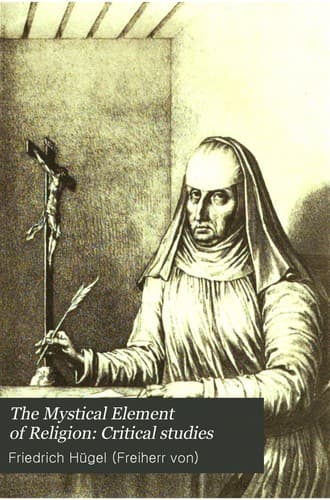
The Mystical Element of Religion, as studied in Saint Catherine of Genoa and her friends, Volume 2 (of 2)Hügel, Friedrich, Freiherr von
Religion
The Mystical Element of Religion, as studied in Saint Catherine of Genoa and her friends, Volume 2 (of 2)
Hügel, Friedrich, Freiherr von
Catherine, of Genoa, Saint, 1447-1510
But there is a further, profoundly and delicately experienced
doctrine. Not only can Pure Love be exercised in single and simple
acts, alongside of single and simple acts of other kinds of virtues,
supernatural or otherwise: but Pure Love can itself come to command
or to inform acts which in themselves bear, and will now bear in
increased degree, the characteristics of the other kinds of acts. St.
Thomas tells us, with admirable clearness: “An act can be derived from
Charity in one of two ways. In the first way, the act is elicited
by Charity itself, and such a virtuous act requires no other virtue
beside Charity,--as in the case of loving the Good, rejoicing in it,
and mourning over its opposite. In the second way, an act proceeds
from Charity in the sense of being commanded by it: and in this
manner,--since Charity” has the full range of and “commands all the
virtues, as ordering them (each and all) to their (ultimate) end,--an
act can proceed from Charity whilst nevertheless belonging to any other
special virtue.” And he assures us that: “The merit of eternal life,”
“the fountain-head of meriting,” “pertains primarily to, consists in
Charity, and pertains to and consists in other kinds of supernatural
acts in only a secondary manner,--that is, only in so far as these acts
are commanded or informed by Charity” or Pure Love.[167]
Let us take some instances of such two-fold manifestations of identical
motives and virtues, according as these motives and virtues operate
in simple co-ordination, or within a compound and organic system. In
the scholar’s life, Greek and Latin and Hebrew may be acquired, each
simply for its own sake and each alongside of the other; or they can be
acquired, from the immediate motive indeed of knowing each in its own
specific nature as thoroughly as possible, yet with the ultimate, ever
more and more conscious and all-penetrating, motive of thus acquiring
means and materials for the science of language, or for the study of
philosophy, or for research into early phases of the Jewish-Christian
religion. In the family life, a man, woman, or child can live for
himself or herself, and then for his or her other immediate relatives,
each taken as separate alongside of the other, or he or she may get
more and more dominated by the conception and claims of the family as
an organic whole, and may end by working largely, even with respect
to himself, as but for so many constituents of that larger organism
in which alone each part can attain its fullest significance. And
especially a young mother can live for her own health and joys, and
then, alongside of these, for those of her child, or she can get to the
point of sustaining her own physical health and her mental hopes and
will to live as so many means and conditions for feeding and fostering
the claimful body and soul of her child.
Public-domain text, read in full here on John Shaqi.
Reviews
Reviews
No reviews yet
Be the first to share your thoughts on this work.
Elsewhere in the archive
Join the Discussion
Join the discussion
Sign in to leave a comment or review.
Sign InorCreate an account