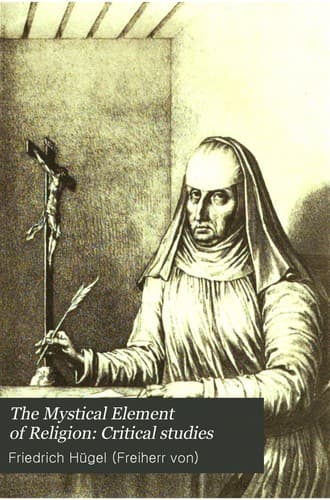
The Mystical Element of Religion, as studied in Saint Catherine of Genoa and her friends, Volume 2 (of 2)Hügel, Friedrich, Freiherr von
Religion
The Mystical Element of Religion, as studied in Saint Catherine of Genoa and her friends, Volume 2 (of 2)
Hügel, Friedrich, Freiherr von
Catherine, of Genoa, Saint, 1447-1510
Yet there is nothing in any Church-censure to prevent, and there is
much in the teaching and life of countless saints to invite, our
holding the possibility, hence the working ideal and standard, for even
here below, of a state in which two kinds of acts, which are still
good in their degree, would be in a considerable minority: acts of
merely natural, unspiritualized hope, fear, desire, etc.; and acts of
supernatural hope, fear, desire, etc., in so far as not commanded by
Charity. For even in this state not fully deliberate venial sins would
occasionally be committed, far more would a certain number of acts
of an unspiritualized, unsupernatural kind occur. And the necessary
variety among the supernatural acts would in nowise be impaired,--it
would indeed be greatly stimulated, by Pure Love being now, for the
most part, the ultimate motive of their exercise.
Sylvius, in his highly authoritative commentary on St. Thomas, puts the
matter admirably: “We may not love God in view of reward in suchwise
as to make eternal life the true and ultimate end of our love, or to
love God because of it, so that without the reward we would not love
Him … We must love God with reference to the eternal reward in suchwise
that we put forth indeed both love and good works in view of such
beatitude,--in so far as the latter is the end proposed to these works
by God Himself; yet that we subordinate this our beatitude to the love
of God as the true and ultimate end,” so that “if we had no beatitude
to expect at all, we should nevertheless still love Him and execute
good works for His own sake alone. In this manner we shall first love
God above all things and for His own sake; and we shall next keep the
eternal reward before us, for the sake of God and of His honour.”[171]
A man in these dispositions would still hope, and desire, and fear,
and regret, and strive for, and aspire to conditions, things, persons
both of earth and of the beyond, both for himself and for others,
both for time and for eternity: but all this, for the most part, from
the ultimate motive, penetrating, deepening, unifying all the other
motives,--of the love of Love, Christ, Spirit, God.
Any hesitation to accept the reality or possibility of such a state
cannot, then, be based upon such acceptance involving any kind of
Quietism, but simply on the admittedly great elevation of such a
condition. Yet this latter objection seems to be sufficiently met if
we continuously insist that even such a state neither exempts souls
from the commission of (more or less deliberate) venial sin; nor is
ever entirely equable; nor is incapable of being completely lost; nor,
as we have just contended, is ever without more or less numerous acts
of an unsupernaturalized kind, and still less without acts of the
supernatural virtues other than Love and unprompted by Love.
Public-domain text, read in full here on John Shaqi.
Reviews
Reviews
No reviews yet
Be the first to share your thoughts on this work.
Elsewhere in the archive
Join the Discussion
Join the discussion
Sign in to leave a comment or review.
Sign InorCreate an account