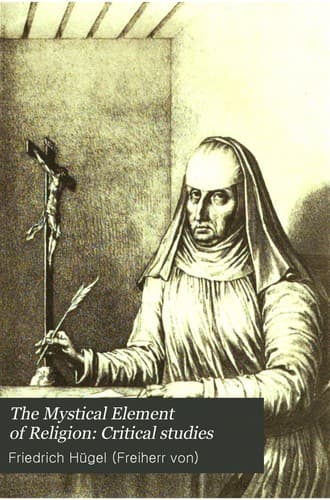
The Mystical Element of Religion, as studied in Saint Catherine of Genoa and her friends, Volume 2 (of 2)Hügel, Friedrich, Freiherr von
Religion
The Mystical Element of Religion, as studied in Saint Catherine of Genoa and her friends, Volume 2 (of 2)
Hügel, Friedrich, Freiherr von
Catherine, of Genoa, Saint, 1447-1510
And all fear of fanaticism will be finally removed by a further most
necessary and grandly enlarging insistence upon the Mercenaries and
even the Servants having passing moments, and producing varyingly
numerous single acts of, Pure Love and of the other supernatural
virtues prompted by Pure Love. All souls in a state of Grace throughout
God’s wide wide world,--every constituent, however slight and recent,
of the great soul of the Church throughout every sex, age, race, clime,
and external organization, would thus have some touches, some at least
incidental beginnings of Pure Love, and of the other supernatural
virtues prompted by Pure Love. All souls would thus, in proportion to
their degree of grace and of fidelity, have some of those touches; and
the progress of all would consist in the degree to which that variety
of acts would become informed and commanded by the supreme motive of
all motives, Pure and Perfect Love.[172]
And with such an Ideal, required by fundamental Catholic positions,
ever increasingly actuating the soul and binding it to all souls
beneath, around, above it, what there is of truth in the savage
attacks of Spinoza and of Kant and of such recent writers as A.
E. Taylor,[173] upon the supposed hypocritical self-seeking in the
practice and temper of average Christians, would lose all its force.
3. _Cognate Problems._
Three much-discussed cognate matters require some elucidation here.
They answer to the questions: Does reference to the self, as for
instance in acts of gratitude and thanksgiving, prevent an act from
being one of Pure Love? Is the pleasurableness, normally ever attached
and subsequent to all virtuous acts, to be regarded as part of the
reward from which Pure Love abstracts? And finally are, I will not say
any technically ecstatic or other in part psycho-physical peculiarities
and manifestations, but even active Contemplation or the simple Prayer
of Quiet, necessary conditions or expressions of a state of Pure
Love,--understood in the sense explained above?
(1) As to reference to the self, it is highly important to distinguish
between acts of Pure Love, and attempts, by means of the maximum
possible degree of abstraction, to apprehend the absolute character
and being of God. For these two things have no necessary connection,
and yet they have been frequently confounded. St. Teresa’s noble
confession of past error, and consequent doubly valuable, amended
teaching is perhaps the most classical pronouncement extant upon this
profoundly important point.[174] The contingent, spacial and temporal,
manifestations and communications of God, above all as we have them in
the life of Our Lord and in those who have come nearest to Him, but
also, in their several degrees and forms, in the lives of each one of
us: all these, in their sacred, awakening and healing, particularity
and closeness of contact, can and should be occasions and materials for
the most perfect, for the purest Love.
Public-domain text, read in full here on John Shaqi.
Reviews
Reviews
No reviews yet
Be the first to share your thoughts on this work.
Elsewhere in the archive
Join the Discussion
Join the discussion
Sign in to leave a comment or review.
Sign InorCreate an account