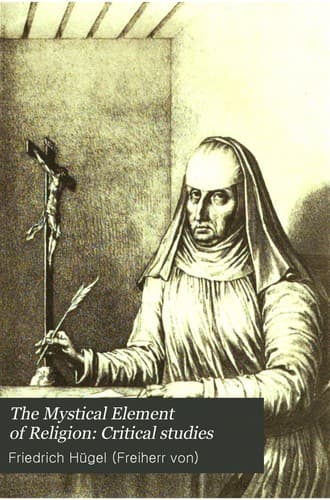
The Mystical Element of Religion, as studied in Saint Catherine of Genoa and her friends, Volume 2 (of 2)Hügel, Friedrich, Freiherr von
Religion
The Mystical Element of Religion, as studied in Saint Catherine of Genoa and her friends, Volume 2 (of 2)
Hügel, Friedrich, Freiherr von
Catherine, of Genoa, Saint, 1447-1510
(2) As to the pleasurableness which, in normal psychic conditions, more
or less immediately accompanies or follows the virtuous acts of the
soul, the realizations of its own deeper and deepest ideals, we should
note that, in its earthly degree and form, it is not included in what
theologians mean by the “rewards” of virtuous action. And in this they
are thoroughly self-consistent, for they adhere, I think with practical
unanimity, to Catherine’s doctrine that these immediate consequences
of virtuous acts are not to be considered a matter of positive and,
as it were, separate divine institution,--as something which, given
the fundamental character of man’s spiritual nature, might have been
otherwise; but as what,--given the immutable nature of God and of the
image at nature in His creature, man,--follows from an intrinsic,
quite spontaneous necessity.--Hence, at this point especially, would
it be foolish and fanatical, because contrary to the immanental nature
of things, and to the right interplay of the elemental forces of all
life, to attempt the suppression even of the several actual irruptions
of such pleasure, and still more of the source and recurrence of this
delectation. Fortunately success is here as impossible as it would be
undesirable,--as much so as, on a lower plane, would be the suppression
of the pleasure concomitant with the necessary kinds and degrees of
eating. Indeed, it is clear, upon reflection that unless a man (at
least implicitly) accepts and (indirectly) wills that spiritual or
physical pleasure, he cannot profitably eat his food or love his God.
But from this in nowise follows what Bossuet tried so hard to
prove,--that what is thus necessarily present in man, as a psychical or
physical prompting and satisfaction, must also of necessity be willed
by him, directly and as his determining reason and justification. In
turning to eat, man cannot help feeling a psychic pleasure of an all
but purely physical kind; and, if he is wise, he will make no attempt
to meddle with this feeling. But he can either deliberately will, as
his action’s object, that pleasure which is thus inevitably incident
to the act, and the more he does so, the more simply greedy and
sensual he will become; or he can directly will, as his determining
end, that sustenance of life and strength for his work and spiritual
growth, which is the justification and ultimate reason of eating (the
_rationale_ of that very pleasure so wisely attached by nature, as a
stimulus, to a process so necessary to the very highest objects), and
the more he does so, the more manly and spiritual he will grow.
Public-domain text, read in full here on John Shaqi.
Reviews
Reviews
No reviews yet
Be the first to share your thoughts on this work.
Elsewhere in the archive
Join the Discussion
Join the discussion
Sign in to leave a comment or review.
Sign InorCreate an account