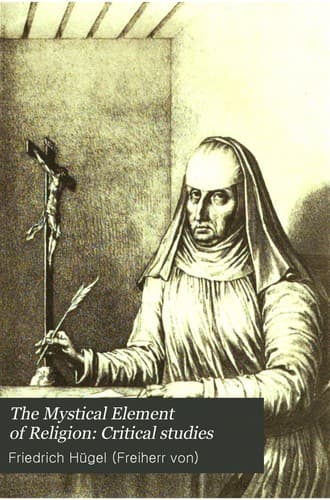
The Mystical Element of Religion, as studied in Saint Catherine of Genoa and her friends, Volume 2 (of 2)Hügel, Friedrich, Freiherr von
Religion
The Mystical Element of Religion, as studied in Saint Catherine of Genoa and her friends, Volume 2 (of 2)
Hügel, Friedrich, Freiherr von
Catherine, of Genoa, Saint, 1447-1510
Indeed it is well never to forget that nothing, and least of all God,
the deepest of all the realities, is known to us at all, except in and
by means of its relation to our own self or to our fellow-creatures.
Hence if Love were Pure only in proportion as it could be based upon
our apprehension of God as independent of all relation to ourselves,
Pure Love would be simply impossible for us.--But, in truth, such a
conception would, in addition, be false in itself: it would imply that
the whole great Incarnation-fact and -doctrine,--the whole of that
great root of all religion, the certainty that it is because God has
first loved us that we can love Him, that He is a self-revealing God,
and One whom we can know and reach because “in Him we live and move
and have our being”--was taking us, not towards, but away from, our
true goal. There are, surely, few sadder and, at bottom, more deeply
uncreaturely, unchristian attitudes, than that which would seek or
measure perfection in and by the greatest possible abstraction from all
those touching contingencies which God Himself has vouchsafed to our
nature,--a nature formed by Himself to require such plentiful contact
with the historical and visible.--And if God’s pure love for us can
and does manifest itself in such contingent acts, then our love can
and should become and manifest itself purer and purer by means, not
only of the prayer of formless abstraction and expectation, but also
by the contemplation of these contingencies and by the production of
analogously contingent acts. And if so, then certainly gratitude, in so
far as it truly deserves the name, can and does belong to Pure Love,
for the very characteristic of such gratitude consists in a desire to
give and not to receive.[175]
Not, then, the degree of disoccupation with the Contingent, even
of the contingent of our own life, but the degree of freedom from
self-seeking, and of the harmonization and subordination of all these
contingencies in and under the supreme motive of the Pure Love and
service of God in man and of man in God, is the standard and test of
Christian perfection.
Public-domain text, read in full here on John Shaqi.
Reviews
Reviews
No reviews yet
Be the first to share your thoughts on this work.
Elsewhere in the archive
Join the Discussion
Join the discussion
Sign in to leave a comment or review.
Sign InorCreate an account