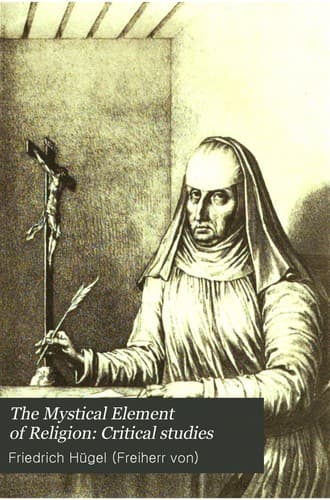
The Mystical Element of Religion, as studied in Saint Catherine of Genoa and her friends, Volume 2 (of 2)Hügel, Friedrich, Freiherr von
Religion
The Mystical Element of Religion, as studied in Saint Catherine of Genoa and her friends, Volume 2 (of 2)
Hügel, Friedrich, Freiherr von
Catherine, of Genoa, Saint, 1447-1510
Abbé Gosselin well sums up the ordinary Catholic teaching. “Meditation
consists of discursive acts which are easily distinguished from each
other, both because of the kind of strain and shock with which they
are produced, and because of the diversity of their objects. It is
the ordinary foundation of the interior life and the ordinary prayer
of beginners, whose imperfect love requires to be thus excited and
sustained by distinct and reflective acts. Contemplation consists,
strictly speaking, in direct ‘non-reflex’ acts,--acts so simple and
peaceful as to have nothing salient by which the soul could distinguish
one from the other. It is called by the Mystical Saints ‘a simple and
loving look,’ as discriminating it from meditation and the latter’s
many methodic and discursive acts, and as limiting it to a simple and
loving consideration and view of God and of divine things, certified
and rendered present to the soul by faith. It is the ordinary prayer
of perfect souls, or at least of those that have already made much
progress in the divine love. For the more purely a soul loves
God, the less it requires to be sustained by distinct, reflective
acts; reasoning becomes a fatigue and an embarrassment to it in its
prayer--it longs but to love and to contemplate the object of its love.”
Or as Fénelon puts it: “‘Passivity,’ ‘Action,’ is not precisely itself
Pure Love, but is the mode in which Pure Love operates.… ‘Passivity,’
‘Action,’ is not precisely the purity of Love, but is the effect of
that purity.”[177] Yet, as M. Gosselin adds, “It must be admitted that
without Contemplation the soul can arrive at a very high perfection;
and that the most discursive meditation, and hence still more all
prayer as it becomes effective, often includes certain direct acts
which form an admixture and beginning of contemplation.”[178]
Public-domain text, read in full here on John Shaqi.
Reviews
Reviews
No reviews yet
Be the first to share your thoughts on this work.
Elsewhere in the archive
Join the Discussion
Join the discussion
Sign in to leave a comment or review.
Sign InorCreate an account