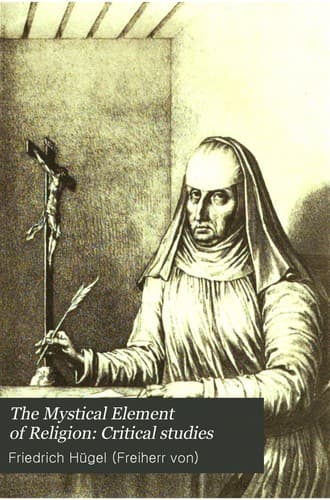
The Mystical Element of Religion, as studied in Saint Catherine of Genoa and her friends, Volume 2 (of 2)Hügel, Friedrich, Freiherr von
Religion
The Mystical Element of Religion, as studied in Saint Catherine of Genoa and her friends, Volume 2 (of 2)
Hügel, Friedrich, Freiherr von
Catherine, of Genoa, Saint, 1447-1510
And as to any supposed necessary relations between the very highest
contemplation and the most complete state of Pure Love on the one hand,
and anything abnormal or miraculous on the other hand, Fénelon, in
this point remarkably more sober than Bossuet, well sums up the most
authoritative and classical Church-teaching on the matter: “‘Passive’
Contemplation is but Pure Contemplation: ‘Active’ Contemplation
being one which is still mixed with hurried and discursive acts.
When Contemplation has ceased to have any remnant of this hurry, of
this ‘activity,’ it is entirely ‘Passive,’ that is, peaceful, in
its acts.” “This free and loving look of the soul means acts of the
understanding,--for it is a look; and acts of the will, for the look
is a loving one; and acts produced by free-will, without any strict
necessity, for the look is a free look.” “We should not compare
Passive Contemplation,” as did Bossuet, “to prophecy, or to the gift
of tongues or of miracles; nor may we say that this mystical state
consists principally in something wrought by God within us without
our co-operation, and where, consequently, there neither is nor can
be any merit. We must, on the contrary, to speak correctly, say that
the substance of such Passive Prayer, taken in its specific acts,
is free, meritorious, and operated within us by a grace that acts
together with us.” “It is the attraction to the acts which the soul
now produces which, as by a secondary and counter-effect, occasions
a quasi-incapacity for those acts which it does not produce. Now
this attraction is not of a kind to deprive the soul of the use of
its free-will: we see this from the nature of the acts which this
attraction causes the soul to produce. Whence I conclude that this
same attraction does not, again, deprive it of its liberty with regard
to the acts which it prevents. The attraction but prevents the latter
in the way it produces the other,--by an efficacious influence that
involves no sheer necessity.” “‘Passivity,’ if it comes from God, ever
leaves the soul fully free for the exercise of the distinct virtues
demanded by God in the Gospel; the _attrait_ is truly divine only
in so far as it draws the soul on to the perfect fulfilment of the
evangelical counsels and promises concerning all the virtues.” “The
inspiration of the Passive state is but an habitual inspiration for
the interior acts of evangelical piety. It renders the Passive soul
neither infallible nor impeccable, nor independent of the Church even
for its interior direction, nor exempt from the obligation of meriting
and growing in virtue.… The inspiration of the passive soul differs
from that of actively just souls only in being purer; that is, more
exempt from all natural self-seeking, more full, more simple, more
continuous, and more developed at each moment. We have, throughout,
ever one and the same inspiration, which but grows in perfection and
purity in proportion as the soul renounces itself more, and becomes
Public-domain text, read in full here on John Shaqi.
Reviews
Reviews
No reviews yet
Be the first to share your thoughts on this work.
Elsewhere in the archive
Join the Discussion
Join the discussion
Sign in to leave a comment or review.
Sign InorCreate an account