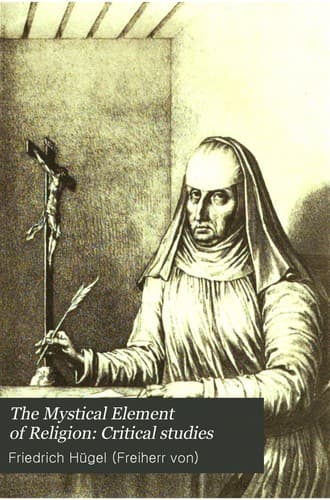
The Mystical Element of Religion, as studied in Saint Catherine of Genoa and her friends, Volume 2 (of 2)Hügel, Friedrich, Freiherr von
Religion
The Mystical Element of Religion, as studied in Saint Catherine of Genoa and her friends, Volume 2 (of 2)
Hügel, Friedrich, Freiherr von
Catherine, of Genoa, Saint, 1447-1510
than such as springs from our own immoral attitude of will.”[183]
In his _Foundation of the Metaphysic of Morals_, 1785, the noble
apostrophe to the Good Will no doubt appears formally to proclaim
as possible and desirable a complete human disposition, in which no
considerations of Happiness play any part: “The good will is good,
not through what it effects or produces, not through its utility for
the attainment of any intention or end, but it is good through the
quality of the volition alone; that is, it is good in itself.…” “If,
with its greatest efforts, nothing were to be effected by it, and only
the good will itself were to remain, this bare will would yet shine in
lonely splendour as a jewel,--as something which has its full value in
itself.” But further on he shows us how, after all, “this good will
cannot, then, be the only and the whole good, but still it is the
highest good and the condition for all the rest, even for our desire of
happiness.”[184] Certain exaggerations, which are next developed by
him here, shall be considered in a later chapter.
5. _Four important points._
Here I will but put together, in conclusion, four positions which I
have rejoiced to find in two such utterly, indeed at times recklessly,
independent writers as Professor Georg Simmel of Berlin and Professor
A. E. Taylor.
(1) Dr. Simmel declares, with admirable cogency: “The concept of
religion completely loses in Kant, owing to his rationalistic manner
of discovering in it a mere compound of the moral interest and the
striving after happiness, its most specific and deepest character.
No doubt these two apprehensions are also essential to religion, but
precisely the direction in which Kant conjoins them,--that duty issues
in happiness, is the least characteristic of religion, and is only
determined by his Moralism, which refuses to recognize the striving
after happiness as a valuable motive. The opposite direction appears to
me as far more decisively a part of religion and of its incomparable
force: for we thus find in religion precisely that ideal power, which
makes it the duty of man to win his own salvation. According to the
Kantian Moralism, it is every man’s private affair how he shall meet
his requirement of happiness; and to turn such a private aspiration
into an objective, ideal claim, would be for Kant a contradiction and
abomination. In reality, however, religion itself _requires_ that man
should have a care for his own welfare and beatitude, and in this
consists its incomparable force of attraction.”[185] Let the reader
note how entirely this agrees with, whilst properly safeguarding, the
doctrine of Pure Love: it is the precise position of the best critics
of the unamended Fénelon.
Public-domain text, read in full here on John Shaqi.
Reviews
Reviews
No reviews yet
Be the first to share your thoughts on this work.
Elsewhere in the archive
Join the Discussion
Join the discussion
Sign in to leave a comment or review.
Sign InorCreate an account