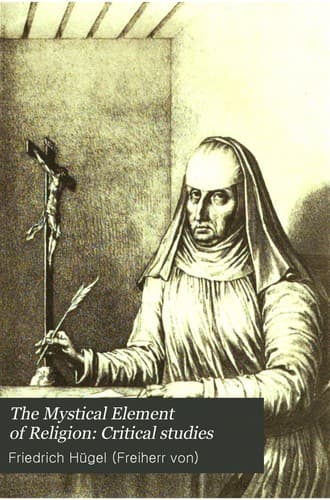
The Mystical Element of Religion, as studied in Saint Catherine of Genoa and her friends, Volume 2 (of 2)Hügel, Friedrich, Freiherr von
Religion
The Mystical Element of Religion, as studied in Saint Catherine of Genoa and her friends, Volume 2 (of 2)
Hügel, Friedrich, Freiherr von
Catherine, of Genoa, Saint, 1447-1510
Certainly the position taken up towards this point in that very
pregnant and curious, largely-overlooked little treatise, _The Canon
of Pure Reason_, which (evidently an earlier and complete sketch), has
been inserted by him into his later, larger, but materially altered
scheme of the _Critique_ of 1781, (where it now forms the _Zweite
Hauptstück_ of the _Transcendentale Methodenlehre_, ed. Kehrbach,
Reclam, pp. 603-628), appears to be substantially acceptable.[182]
“Happiness consists in the satisfaction of all our inclinations,
according to their various character, intensity, and duration. The
law of practical action, in so far as it is derived from the motive
of happiness, I call Pragmatic, a Rule of Good Sense; the same law,
in so far as it has for its motive only the becoming worthy of such
happiness, I call Moral, the Moral Law. Now Morality already by itself
constitutes a system, but Happiness does not do so, except in so far as
Happiness is distributed in exact accordance with Morality. But such a
distribution is only possible in the intelligible world,”--the world
beyond phenomena which can be reached by our reason alone--“and under
a wise Originator and Ruler. Such an One, together with life in such a
world--a world which we are obliged to consider as a future one--reason
finds itself forced to assume, or else to look upon the moral laws as
empty phantoms, since the necessary result of these laws,--a result
which that same reason connects with their very idea,--would have to
fall away, if that assumption were to go. Hence every one looks upon
the moral laws as _commandments_, a thing which they could not be,
if they did not conjoin with their rule consequences of _a priori_
appropriateness, and hence if they did not carry with them _promises_
and _threats_. But this too they can do only if they lie within the
compass of a Single Necessary Being, Itself the Supreme Good, Which
alone can render possible such a unity embracing both means and
end.--Happiness alone is, for our reason, far from being the Complete
Good, for reason does not approve of Happiness unless it be united with
the being worthy of Happiness, _i.e._ Moral Rectitude. But Morality
alone, and with it the simple being worthy of happiness, is also far
from the Complete Good. Even if reason, free from any consideration of
any interest of its own, were to put itself in the position of a being
that had to distribute all happiness to others alone, it could not
judge otherwise: for, in the complete idea of practical action, both
points are in essential conjunction, yet in suchwise that it is the
moral disposition which, as condition, first renders possible a sharing
in happiness, and not the prospect of happiness which first gives
an opening to the moral disposition. For, in this latter case, the
disposition would not be moral, and, consequently, would not deserve
that complete happiness to which reason can assign no other limitation
Public-domain text, read in full here on John Shaqi.
Reviews
Reviews
No reviews yet
Be the first to share your thoughts on this work.
Elsewhere in the archive
Join the Discussion
Join the discussion
Sign in to leave a comment or review.
Sign InorCreate an account