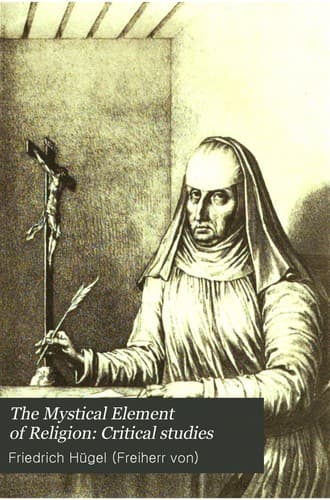
The Mystical Element of Religion, as studied in Saint Catherine of Genoa and her friends, Volume 2 (of 2)Hügel, Friedrich, Freiherr von
Religion
The Mystical Element of Religion, as studied in Saint Catherine of Genoa and her friends, Volume 2 (of 2)
Hügel, Friedrich, Freiherr von
Catherine, of Genoa, Saint, 1447-1510
Here Fénelon has adequately interpreted the permanent and complete
requirements of the religious life and spirit. “You tell me,” he
says to his adversaries, “that ‘Christianity is not a school of
Metaphysicians.’ All Christians cannot, it is true, be Metaphysicians;
but the principal Theologians have great need to be such. It was by a
sublime Metaphysic that St. Augustine soared above the majority of the
other Fathers, who were, for the rest, as fully versed in Scripture
and Tradition. It was by his lofty Metaphysic that St. Gregory of
Nazianzum has merited the distinguishing title of _Theologian_.
It is by Metaphysic that St. Anselm and St. Thomas have been such
great luminaries of the Church. True, the Church is not ‘a school of
Metaphysicians,’ who dispute without docility, as did the ancient sects
of philosophers. Yet she is a school in which St. Paul teaches that
Charity is more perfect than Hope, and in which the holiest Doctors
declare, in accordance with the principles of the Fathers, that Love
is more perfect, precisely because it ‘abides in God, not in view of
any benefit that may accrue to us from so doing.’” “I know well,” he
writes to a friend, “that men misuse the doctrines of Pure Love and
Resignation; I know that there are hypocrites who, under cover of
such noble terms, overthrow the Gospel. Yet it is the worst of all
procedures to attempt the destruction of perfect things, from a fear
that men will make a wrong use of them.” Notwithstanding all misuse of
the doctrine--“the very perfection of Christianity is Pure Love.”[190]
CHAPTER XII
THE AFTER-LIFE PROBLEMS AND DOCTRINES
Moving on now to the questions concerning the After-Life, it
will be convenient to consider them under five heads: the chief
present-day positions and perplexities with regard to belief in
the After-Life in General; the main implications and convictions
inherent to an Eschatology such as Catherine’s; and then the principal
characteristics, difficulties, and helps of her tendencies and
teachings concerning Hell, Purgatory, and Heaven. And throughout the
Chapter we shall busy ourselves directly only with the After-Life in
the sense of a heightened, or at least an equal, consciousness after
death, as compared to that which existed before death: the belief in
a shrunken state of survival, in non-annihilation, appearing to be as
certainly the universal minimum of belief as such a minimum is not
Immortality.
I. THE CHIEF PRESENT-DAY PROBLEMS, PERPLEXITIES, AND REQUIREMENTS WITH
REGARD TO THE AFTER-LIFE IN GENERAL.
Now I take our chief present-day problems, perplexities, and resultant
requirements with regard to the After-Life in general, to fall into
three groups, according as those problems are predominantly Historical,
or Philosophical, or directly Practical and Ethical.
1. _Three Historical Difficulties._
Public-domain text, read in full here on John Shaqi.
Reviews
Reviews
No reviews yet
Be the first to share your thoughts on this work.
Elsewhere in the archive
Join the Discussion
Join the discussion
Sign in to leave a comment or review.
Sign InorCreate an account