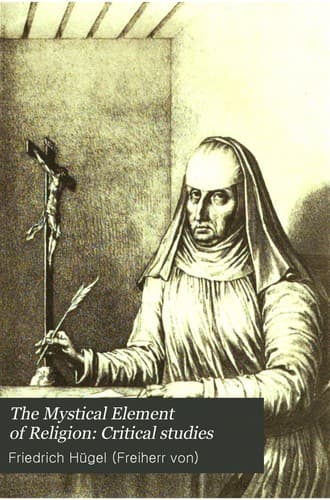
The Mystical Element of Religion, as studied in Saint Catherine of Genoa and her friends, Volume 2 (of 2)Hügel, Friedrich, Freiherr von
Religion
The Mystical Element of Religion, as studied in Saint Catherine of Genoa and her friends, Volume 2 (of 2)
Hügel, Friedrich, Freiherr von
Catherine, of Genoa, Saint, 1447-1510
The Historical group now brings very clearly and certainly before
us the striking non-universality, the startling lateness, and
the generally strange fitfulness and apparent unreasonableness
characterizing the earliest stage of belief in the soul’s heightened,
or at least equivalent, consciousness after death.
(1) Now with respect to the Non-Universality of the doctrine, it
is true that, in China, Confucianism is full of care for the dead.
“Throughout the Empire, the authorities are obliged to hold three
annual sacrifices for the refreshment and rest of the souls of the dead
in general.” “It is hardly doubtful that the cultus of Ancestors formed
the chief institution in classical Confucianism, and constituted the
very centre of religion for the people. Even now ancestor-worship is
the only form of religion for which rules, applicable to the various
classes among the Emperor’s subjects, are laid down in the Dynastic
Statutes.” And Professor De Groot, from whom I am quoting, gives an
interesting conspectus of the numberless ways in which the religious
service of the dead penetrates Chinese life.[191]--Yet we hear of
Kong-Tse (Confucius) himself (551-478 B.C.), that, though he insisted
upon the most scrupulous execution of the three hundred rules of the
then extant temple-ceremonial, which were no doubt largely busy with
the dead, and though he said that one should sacrifice to the spirits
as if they were present, he designated, in several of his sayings,
occupation with theological problems as useless: “as long as we do not
know men, how shall we know spirits? As long as we do not understand
life, how should we fathom death?” And to questions relative to the
spirits and the dead, he would give evasive answers.[192] Thus the
founder of the most characteristic of the Chinese religions was without
any clear and consistent conviction on the point in question.
In India we find, for Brahmanic religion, certain unmistakable
Immortality-Doctrines (in the sense of the survival of the soul’s
self-consciousness), expressed in the hymns of the _Rig-Veda_.--But
already, in the philosophizings of the _Upanishads_, we get a
world-soul, and this soul’s exclusive permanence: “to attain to true
unity, the very duality of subject and object is to disappear. The
terms Atman and Brahman here express the true Being which vivifies all
beings and appearances, and with which cognizing man reunites himself
whilst losing his individual existence.”[193]
Public-domain text, read in full here on John Shaqi.
Reviews
Reviews
No reviews yet
Be the first to share your thoughts on this work.
Elsewhere in the archive
Join the Discussion
Join the discussion
Sign in to leave a comment or review.
Sign InorCreate an account