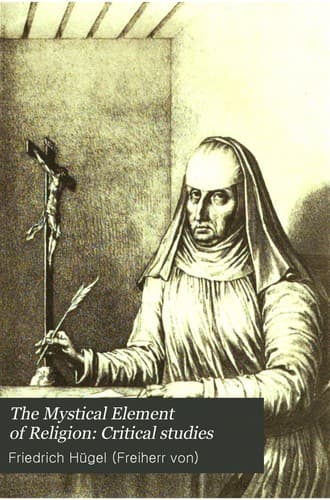
The Mystical Element of Religion, as studied in Saint Catherine of Genoa and her friends, Volume 2 (of 2)Hügel, Friedrich, Freiherr von
Religion
The Mystical Element of Religion, as studied in Saint Catherine of Genoa and her friends, Volume 2 (of 2)
Hügel, Friedrich, Freiherr von
Catherine, of Genoa, Saint, 1447-1510
“Buddhism,” so Oldenberg sums up the matter, with, I think, the
substantial adhesion of all present-day competent authorities, “teaches
that there is a way out of the world of created things, out into the
dark Infinite. Does this way lead to new being? or does it lead to
nothingness? Buddhist belief maintains itself on the knife’s edge
of these alternatives. The desire of the heart, as it longs for the
Eternal, is not left without something, and yet the thinking mind is
not given a something that it could grasp and retain. The thought
of the Infinite, the Eternal, could not be present at all, and yet
vanish further away than here, where, a mere breath and on the
point of sinking into sheer nothingness, it threatens to disappear
altogether.”[194] This vast Buddhist community, numbering, perhaps, a
third of the human race, should not, then, be forgotten, when we urge
the contrary instances of the religions of Assyria and Babylonia; of
Egypt; of Greece and Rome; and, above all, of the Jews and Christianity.
Yet it is well to remember that such non-universality of belief is at
least as real, to this very hour, for such a fundamental religious
truth and practice as Monotheism and Monolatry; such purely Ethical
convictions as Monogamy and the Illicitness of Slavery; such a plain
dictate of the universal humanitarian ideal as the illegitimacy
of the application of physical compulsion in matters of religious
conviction; and such directly demonstrable psychical and natural facts
as subconsciousness in the human soul, the sexual character of plants,
and the earth’s rotundity and rotation around the sun. In none of these
cases can we claim more than that the higher, truer doctrine,--that is,
the one which explains and transcends the element of truth contained in
its predecessor and opposite,--is explicitly reached by a part only of
humanity, and is but implied and required by other men, at their best.
Yet this is clearly enough for leaving us free to decide,--reasonably
conclusive evidence for their truth being forthcoming,--in favour of
the views of the minority: since the assumption of an equality of
spiritual and moral insight and advance throughout mankind is as little
based upon fact, as would be the supposition of men’s equal physical
strength or height, or of any other quality or circumstance of their
nature and environment.
(2) The lateness of the doctrine’s appearance, precisely in the cases
where there can be no doubt of its standing for a conviction of an
endless persistence of a heightened consciousness after death,--that
is, amongst the Greeks (and Romans) and the Jews (and Christians),--has
now been well established by critical historical research.
Public-domain text, read in full here on John Shaqi.
Reviews
Reviews
No reviews yet
Be the first to share your thoughts on this work.
Elsewhere in the archive
Join the Discussion
Join the discussion
Sign in to leave a comment or review.
Sign InorCreate an account