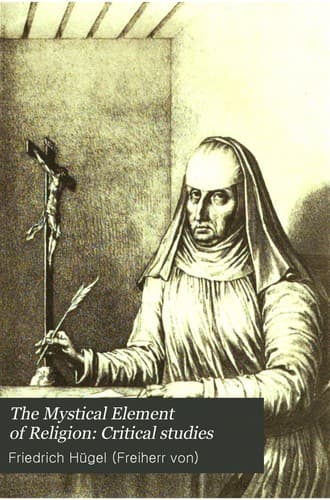
The Mystical Element of Religion, as studied in Saint Catherine of Genoa and her friends, Volume 2 (of 2)Hügel, Friedrich, Freiherr von
Religion
The Mystical Element of Religion, as studied in Saint Catherine of Genoa and her friends, Volume 2 (of 2)
Hügel, Friedrich, Freiherr von
Catherine, of Genoa, Saint, 1447-1510
With regard to the Greeks,[195] the matter is particularly plain,
since we can still trace even in Plato, (427 to 347 B.C.), who, next
to Our Lord Himself and to St. Paul, is doubtless the greatest and
most influential teacher of full individual Immortality that the world
has seen, two periods of thought in this matter, and can show that
the first was without any such certain conviction. In his _Apology of
Socrates_, written soon after the execution in 399 B.C., he makes his
great master, close to his end, declare that death would bring to man
either a complete unconsciousness, like to a dreamless sleep, or a
transition into another life,--a life here pictured like to the Homeric
Hades. Both possibilities Socrates made to accept resignedly, in full
reliance on the justice of the Gods, and to look no further; how should
he know what is known to no man?--And this is Plato’s own earlier
teaching. For in the very _Republic_ which, in its chronologically
later constituents, (especially in Book V, 471_c_, to the end of
Book VIII, Book IX, 560_d_ to 588_a_, and Book X up to 608_b_), so
insists upon and develops the truth and importance of Immortality in
the strictest, indeed the sublimest sense: we get, in its earlier
portions, (especially in Book II, 10_c_, to Book V, 460_c_), no trace
of any such conviction. For, in these earlier passages, the Guardians
in the Ideal State are not to consider what may come after death: the
central theme is the manner in which Justice carries with it its own
recompense; and the rewards, that are popularly wont to be placed
before the soul, are referred to ironically,--Socrates is determined to
do without such hopes. In those later portions, on the contrary, there
is the greatest insistence upon the importance of caring, not for this
short life alone, but for the soul’s “whole time” and for what awaits
it after death. And in the still later parts, (as in Books VI and VII),
the sublimest form of Immortality is presupposed as true and actual
throughout. Thus in Greece it is not till about 390-380 B.C., and in
Plato himself not till his middle life, that we get a quite definite
and final doctrine of the Immortality of all souls, and of a blessed
after-existence for every just and holy life here below.
Public-domain text, read in full here on John Shaqi.
Reviews
Reviews
No reviews yet
Be the first to share your thoughts on this work.
Elsewhere in the archive
Join the Discussion
Join the discussion
Sign in to leave a comment or review.
Sign InorCreate an account