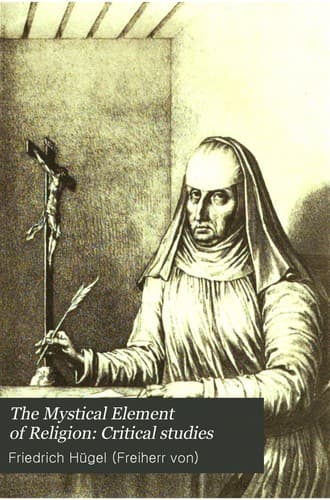
The Mystical Element of Religion, as studied in Saint Catherine of Genoa and her friends, Volume 2 (of 2)Hügel, Friedrich, Freiherr von
Religion
The Mystical Element of Religion, as studied in Saint Catherine of Genoa and her friends, Volume 2 (of 2)
Hügel, Friedrich, Freiherr von
Catherine, of Genoa, Saint, 1447-1510
And then, among the poets who bridge over the period up to Plato, we
find Pindar, who, alongside of reproductions of the ordinary, popular
conceptions, gives us at times lofty, Orphic-like teachings as to
the eternity, the migration, and the eventual persistent rest and
happiness of the just Soul, and as to the suffering of the unjust one;
Aeschylus, who primarily dwells upon the Gods’ judgment in this life,
and who makes occasional allusions to the after-life which are partly
still of the Homeric type; Sophocles, who indeed refers to the special
privileges which, in the after-life, attend upon the souls that have
here been initiated into the Eleusinian Mysteries, and who causes
Oedipus to be translated, whilst still alive, to Other-World happiness,
but who knows nothing of an unceasing heightened consciousness
for all men after death; and Euripides, who, showing plainly the
influence of the Sophists, gives expression, alongside of Pantheistic
identifications of the soul and of the aether, to every kind of
misgiving and doubt as to any survival after death.
And as to the appearance of the doctrine among the Jews, we again find
a surprising lateness. I follow here, with but minor contributions
and modifications from other writers and myself, the main conclusions
of Dr. Charles’s standard _Critical History of the Doctrine of a
Future Life_, London, 1899, whose close knowledge of the subject is
unsurpassed, and who finds as many and as early attestations as are
well-nigh findable by serious workers.[197]
“The primitive beliefs of the individual Israelite regarding the future
life, being derived from Ancestor-worship, were implicitly antagonistic
to Yahwism, from its first proclamation by Moses.… This antagonism
becomes explicit and results in the final triumph of Yahwism.” And
to the early Israelite, even under Yahwism, “the religious unit was”
not the individual but “the family or tribe.” Thus, even fully six
centuries after Moses, “the message of the prophets of the eighth
century,” Amos, Hosea, Isaiah, Micah, “is still directed to the
nation, and the judgments they proclaim are collective punishment for
collective guilt. It is not till late in the seventh century B.C. that
the problem of individual retribution really emerged, and received
its first solution in the teaching of Jeremiah.” And “the further
development of these ideas,” by the teaching of Ezekiel and of some
of the Psalms and Proverbs, as regards individual responsibility
and retribution in this life, and by the deep misgivings and keen
questionings of Job and Ecclesiastes, as to the adequacy of this
teaching, “led inevitably to the conception of a blessed life beyond
the grave.”
Public-domain text, read in full here on John Shaqi.
Reviews
Reviews
No reviews yet
Be the first to share your thoughts on this work.
Elsewhere in the archive
Join the Discussion
Join the discussion
Sign in to leave a comment or review.
Sign InorCreate an account