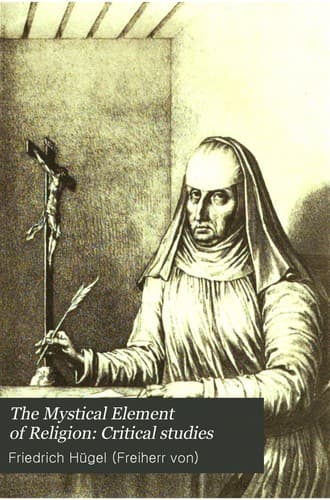
The Mystical Element of Religion, as studied in Saint Catherine of Genoa and her friends, Volume 2 (of 2)Hügel, Friedrich, Freiherr von
Religion
The Mystical Element of Religion, as studied in Saint Catherine of Genoa and her friends, Volume 2 (of 2)
Hügel, Friedrich, Freiherr von
Catherine, of Genoa, Saint, 1447-1510
The Cultus of the Nether-World Deities, of the Departed generally, and,
as the culmination of all this movement, the Eleusinian Mysteries,
must not be conceived as involving or as leading to, any belief in the
ecstatic elevation of the soul, or consciousness of its God-likeness;
and such unending bliss as is secured, is gained by men, not because
they are virtuous and devout, but through their initiation into the
Mysteries. Rhode assures us, rightly I think, that “it remains unproved
that, during the classical period of Greek culture, the belief in
Judges and a Judgment to be held in Hades over the deeds done by men on
earth, had struck root among the people”; Professor Percy Gardner adds
his great authority to the same conclusion.[196] Here again it is Plato
who is the first to take up a clearly and consistently spiritual and
universalistic position.
Indeed it is only in the predominantly neuropathic, indeed largely
immoral and repulsive, forms of the Dionysiac sect and movement, (at
work, perhaps, already in the eighth century B.C. and which leads
on to the formation of the more aristocratic and priestly Orphic
communities) that a demonstrable and direct belief arose in the soul’s
intrinsic God-likeness, or even divinity, and in its immortality,
or even eternity; and that stimulations, materials, and conceptions
were furnished to Greek thought, which are traceable wheresoever it
henceforth inclines to belief in the soul’s intrinsic Immortality.
Yet the leaven spread but slowly into philosophy. For the Ionian
philosophers, and among them Heraclitus, the impressive teacher of
the flux of all things, flourish from about 600 to 430 B.C.; but,
_naïve_ Materialists and Pantheists as they are, they frankly exclude
all survival of individual consciousness after death. The Eleatic
philosophers live between 550 and 450 B.C., and are all busy with _a
priori_ logical constructions of the physical world, conceived as sole
and self-explanatory; and amongst them is Parmenides, the powerful
propounder of the complete identity and immutability of all reality.
Those transcendent spiritual beliefs appear first as part, indeed as
the very foundation, although still rather of a mode of life than of
a formal philosophy, in the teaching and community of Pythagoras, who
seems to have lived about 580 to 490 B.C., and who certainly emigrated
from Asia Minor to Croton in Southern Italy. The soul appears here
as intrinsically immortal, indeed without beginning and without end.
And then Immortality forms one (the mystical) of the two thoroughly
heterogeneous elements of the, otherwise predominantly Ionic and
Materialistic, philosophy of Empedocles of Agrigentum in Sicily, about
490 to 435 B.C. In both these cases the Dionysiac-Orphic provenance of
the “Immortality”-doctrines is clearly apparent.
Public-domain text, read in full here on John Shaqi.
Reviews
Reviews
No reviews yet
Be the first to share your thoughts on this work.
Elsewhere in the archive
Join the Discussion
Join the discussion
Sign in to leave a comment or review.
Sign InorCreate an account