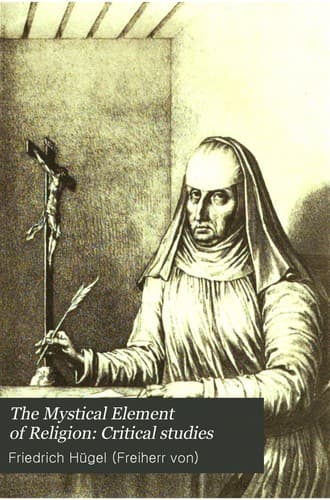
The Mystical Element of Religion, as studied in Saint Catherine of Genoa and her friends, Volume 2 (of 2)Hügel, Friedrich, Freiherr von
Religion
The Mystical Element of Religion, as studied in Saint Catherine of Genoa and her friends, Volume 2 (of 2)
Hügel, Friedrich, Freiherr von
Catherine, of Genoa, Saint, 1447-1510
(3) And as to the supposed directly beneficial effects of a positive
denial of Immortality, such as have been sung for us by George
Eliot and Giovanni Pascoli, we can safely affirm that the special
tendernesses and quiet heroisms, deduced by them from such a negation,
are too obviously dependent upon spiritual implications and instincts,
for us to be able to put them directly to the credit of that denial.
Only in so far as Immortality were not a postulate intrinsically
connected with belief in objective and obligatory Beauty, Truth, and
Goodness,--in God as our origin and end,--could its persistent and
deliberate denial not be injurious to these fundamental convictions
and to the ultimate health of the soul’s life: and of this intrinsic
non-connection there is no sufficient evidence.--Certainly, in such
a case as Spinoza’s, the same strain of reasoning which makes him
abandon individual Immortality Ought, in logic, to prevent him, a
mere hopelessly determined link in the _Natura Naturata_, from ever
attaining to the free self-dedication of himself, as now a fully
responsible member of the _Natura Naturans_. And if not all the grand
depth of his spiritual instinct and moral nobility, and its persistence
in spite of its having no logical room in the fixedly naturalistic
element of his teaching, can be urged as an argument in favour of the
ultimate truth and ethical helpfulness of that whole element, neither
can it be urged with respect to what is presumably one part of that
element, his denial of personal Immortality.
II. CATHERINE’S GENERAL AFTER-LIFE CONCEPTIONS.
Now Catherine’s general After-Life Conceptions in part bring into
interesting prominence, in part really meet and overcome, the
perplexities and mutually destructive alternatives which we have just
considered. I shall here again leave over to the next chapter the
simply ultimate questions, such as that of the pure Eternity _versus_
the Unendingness of the soul; but shall allow myself, as to one set
of her general ideas, a little digression as to the probability of
their ultimate literary suggestion by Plato.--These Platonic passages
probably reached her too indirectly, and by means and in forms which I
have too entirely failed to discover, for me to be able to discuss them
in my chapter devoted to her assured and demonstrably direct literary
sources. But these sayings of Plato greatly help to illustrate the
meaning of her doctrine.--I shall group these, her general, positions
and implications under four heads, and shall consider three of these
as, in substance, profoundly satisfactory, but one of them, the second,
as acceptable only with many limitations, although this second has
obviously much influenced the form given by her to several of those
other conceptions.
1. _Forecasts of the Hereafter, based upon present experience._
Public-domain text, read in full here on John Shaqi.
Reviews
Reviews
No reviews yet
Be the first to share your thoughts on this work.
Elsewhere in the archive
Join the Discussion
Join the discussion
Sign in to leave a comment or review.
Sign InorCreate an account