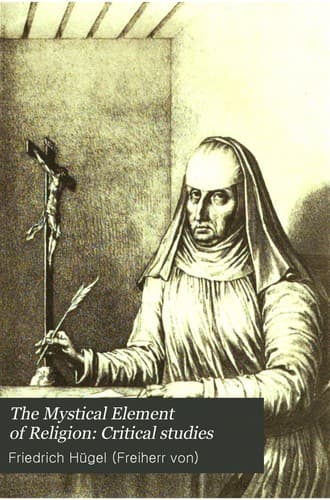
The Mystical Element of Religion, as studied in Saint Catherine of Genoa and her friends, Volume 2 (of 2)Hügel, Friedrich, Freiherr von
Religion
The Mystical Element of Religion, as studied in Saint Catherine of Genoa and her friends, Volume 2 (of 2)
Hügel, Friedrich, Freiherr von
Catherine, of Genoa, Saint, 1447-1510
First, then, we get, as the fundamental presupposition of the
whole Eschatology, a grandly sane, simple, and profound doctrine
formulated over and over again and applied throughout, with a splendid
consistency, as the key and limit to all her anticipations and
picturings. Only because of the fact, and of our conviction of the
fact, of the unbroken continuity and identity of God with Himself,
of the human soul with itself, and of the deepest of the relations
subsisting between that God and the soul, across the chasm formed by
our body’s death, and only in proportion as we can and do experience
and achieve, during this our earthly life, certain spiritual laws and
realities of a sufficiently elemental, universal, and fruitful, more or
less time- and space-less character, can we (whilst ever remembering
the analogical nature of such picturings even as to the soul’s life
here) safely and profitably forecast certain general features of the
future which is thus already so largely a present. But, given these
conditions in the present, we can and should forecast the future,
to the extent implied. And as Plato’s great imaginative projection,
his life-work, the _Republic_, achieves its original end, (of making
more readily understandable, by objectivizing on a large scale, the
life of the inner city of our own soul), in so far as he has rightly
understood the human soul and has found appropriate representations
of its powers, laws, and ideals in his future commonwealth, even
if we cannot accept this picture for political purposes and in all
its details: so is it also with Catherine’s projection, which, if
bolder in its subject-matter, is, most rightly, indefinitely more
general in its indications than is Plato’s great diagram of the soul.
Man’s spiritual personality, being held by her to survive death,--to
retain its identity and an at least equivalent consciousness, of that
identity,--the deepest experiences of that personality before the
body’s death are conceived as re-experienced by it, in a heightened
degree and form, after death itself. Hence these great pictures, of
what the soul will experience then, would remain profoundly true of
what the soul seeks and requires now, even if there were no _then_ at
all.
And note particularly how only with regard to one stage and condition
of the spirit’s future life,--that of the purification of the imperfect
soul,--does she indulge in any at all direct doctrine or detailed
picturing; and this, doubtless, not only because she has experienced
much concerning this matter in her own life here, but also because
the projection of these experiences would still give us, not the
ultimate state, but more or less only a prolongation of our mixed,
joy-in-suffering life upon earth. As to the two ultimate states, we get
only quite incidental glimpses, although even these are strongly marked
by her general position and method.
2. _Catherine’s forecasts and present experience correspondingly
limited._
Public-domain text, read in full here on John Shaqi.
Reviews
Reviews
No reviews yet
Be the first to share your thoughts on this work.
Elsewhere in the archive
Join the Discussion
Join the discussion
Sign in to leave a comment or review.
Sign InorCreate an account