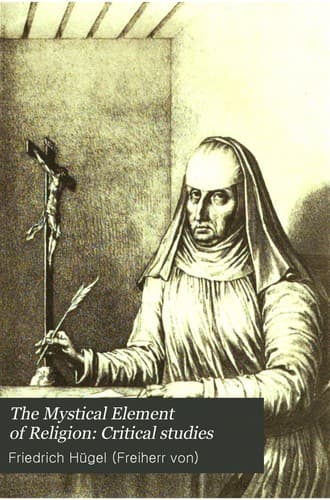
The Mystical Element of Religion, as studied in Saint Catherine of Genoa and her friends, Volume 2 (of 2)Hügel, Friedrich, Freiherr von
Religion
The Mystical Element of Religion, as studied in Saint Catherine of Genoa and her friends, Volume 2 (of 2)
Hügel, Friedrich, Freiherr von
Catherine, of Genoa, Saint, 1447-1510
And next, coming to the projection itself, we naturally find it
to present all the strength and limitations of her own spiritual
experiences which are thus projected: her attitude towards the body
and towards human fellowship, (two subjects which are shown to be
closely inter-related by the continuous manner in which they stand
and fall together throughout the history of philosophy and religion,)
thus constitute the second general peculiarity of her Eschatology. We
have already noted, in her life, her strongly ecstatic, body-ignoring,
body-escaping type of religion; and how, even in her case, it tended to
starve the corporate, institutional conceptions and affections. Here,
in the projection, we find both the cause and the effect again, and on
a larger scale. Her continuous psycho-physical discomforts and keen
thirst for a unity and simplicity as rapid and complete as possible,
the joy and strength derived from ecstatic habits and affinities, would
all make her, without even herself being aware of it, drop all further
thought as to the future fate of that oppressive “prison-house” from
which her spirit had at last got free.
Now such non-occupation with the fate of the body and of her
fellow-souls may appear quite appropriate in her Purgatorial
Eschatology, yet we cannot but find that, even here, it already
possesses grave disadvantages, and that it persists throughout all her
After-life conceptions. For in all the states and stages of the soul we
get a markedly unsocial, a _sola cum solo_ picture. And yet there is,
perhaps, no more striking difference, amongst their many affinities,
between Platonism and Christianity than the intense Individualism
which marks the great Greek’s doctrine, and the profoundly social
conception which pervades Our Lord’s own teaching,--in each case as
regards the next life as well as this one. Plotinus’s great culminating
commendation of “the flight of the alone to the Alone” continues
Plato’s tradition; whereas, if even St. Paul and the Joannine writings
speak at times as though the individual soul attained to its full
personality in and by direct intercourse with God alone, the Synoptic
Gospels, and at bottom also those two great lovers of Our Lord’s
spirit, never cease to emphasize the social constituent of the soul’s
life both here and hereafter. The Kingdom of Heaven, the Soul of
the Church, as truly constitutes the different personalities, their
spirituality and their joy, as they constitute it,--that great Organism
which, as such, is both first and last in the Divine thought and love.
Public-domain text, read in full here on John Shaqi.
Reviews
Reviews
No reviews yet
Be the first to share your thoughts on this work.
Elsewhere in the archive
Join the Discussion
Join the discussion
Sign in to leave a comment or review.
Sign InorCreate an account