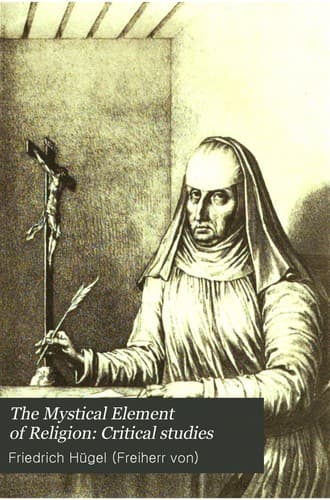
The Mystical Element of Religion, as studied in Saint Catherine of Genoa and her friends, Volume 2 (of 2)Hügel, Friedrich, Freiherr von
Religion
The Mystical Element of Religion, as studied in Saint Catherine of Genoa and her friends, Volume 2 (of 2)
Hügel, Friedrich, Freiherr von
Catherine, of Genoa, Saint, 1447-1510
Catherine’s third peculiarity consists in a rich and profound
organization of two doctrines, the one libertarian, the other
determinist; and requires considerable quotation from Plato, whose
teachings, bereft of all transmigration-fancies, seem clearly to
reappear here, (however complex may have been the mediation,) in
Catherine’s great conception.
The determinist doctrine maintains that virtue and vice, in proportion
as they are allowed their full development, spontaneously and
necessarily attain to their own congenital consummation, a consummation
which consists, respectively, in the bliss inseparable from the final
and complete identity between the inevitable results upon itself of
the soul’s deliberate endeavours, and the indestructible requirements
of this same soul’s fundamental nature; and in the misery of the, now
fully felt but only gradually superable, or even, in other cases,
insuperable, antagonism between the inevitable consequences within its
own self of the soul’s more or less deliberate choosings, and those
same, here also ineradicable, demands of its own truest nature.
As Marsilio Ficino says, in his _Theologia Platonica_, published in
Florence in 1482: “Virtue is reward in its first budding, reward is
virtue full-grown. Vice is punishment at the moment of its birth;
punishment is vice at its consummation. For, in each of these cases,
one and the same thing is first the simple seed and then the full ear
of corn; and one and the same thing is the full ear of corn and then
the food of man. Precisely the very things then that we sow in this our
(earthly) autumn, shall we reap in that (other-world) summer-day.”[204]
It is true that forensic terms and images are also not wanting in
Catherine’s sayings; but these, in part, run simply parallel to the
immanental conception without modifying it; in part, they are in
its service; and, in part, they are the work of the theologians’
arrangements and glosses discussed in my Appendix.
And the libertarian doctrine declares that it is the soul itself which,
in the beyond and immediately after death, chooses the least painful,
because the most expressive of her then actual desires, from among the
states which the natural effects upon her own self of her own earthly
choosings have left her interiorly free to choose.
Public-domain text, read in full here on John Shaqi.
Reviews
Reviews
No reviews yet
Be the first to share your thoughts on this work.
Elsewhere in the archive
Join the Discussion
Join the discussion
Sign in to leave a comment or review.
Sign InorCreate an account