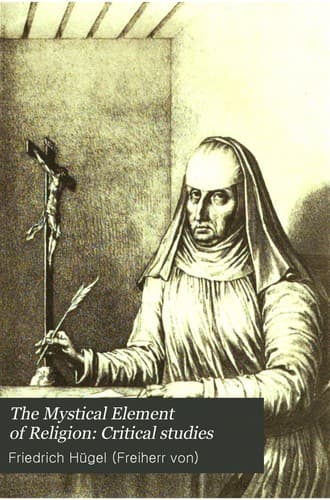
The Mystical Element of Religion, as studied in Saint Catherine of Genoa and her friends, Volume 2 (of 2)Hügel, Friedrich, Freiherr von
Religion
The Mystical Element of Religion, as studied in Saint Catherine of Genoa and her friends, Volume 2 (of 2)
Hügel, Friedrich, Freiherr von
Catherine, of Genoa, Saint, 1447-1510
Now it is in this second doctrine especially that we find so detailed
an anticipation by Plato of a whole number of highly original and
characteristic points and combinations of points, as to render a
fortuitous concurrence between Catherine and Plato practically
impossible. Yet I have sought in vain, among Catherine’s authentic
sayings, actions, possessions, or friends, for any trace of direct
acquaintance with any of Plato’s writings. But Ficino’s Latin
translation of Plato, published, with immense applause, in Florence in
1483, 1484, must have been known, in those intensely Platonizing times,
to even non-professed Humanists in Genoa, long before Catherine’s death
in 1510, so that one or other of her intimates may have communicated
the substance of these Platonic doctrines to her.[205] Plotinus, of
whom Ficino published a Latin translation in 1492, contains but a
feeble echo of Plato on this point. Proclus, directly known only very
little till much after Catherine’s time, is in even worse case. The
Areopagite, who has so continuously taken over whole passages from
all three writers, although directly almost exclusively from Proclus,
contains nothing more immediately to the purpose than his impressive
sayings concerning Providence’s continuous non-forcing of the human
personality in its fundamental constitution and its free elections with
their inevitable consequences; hence Catherine cannot have derived her
ideas, in the crisp definiteness which they retain in her sayings, from
her cousin the Dominican nun and the Areopagite. And it is certain, as
we have seen, how scattered and inchoate are the hints which she may
have found in St. Paul, the Joannine writings, and Jacopone da Todi.
St. Augustine contains nothing that would be directly available,--an
otherwise likely source considering Catherine’s close connection with
the Augustinian Canonesses of S. Maria delle Grazie.
In Plato, then, we get five conceptions and symbolic pictures that are
practically identical with those of Catherine.
(1) First we get the conception of souls having each, in exact
accordance with the respective differences of their moral and spiritual
disposition and character, as these have been constituted by them here
below, a “place” or environment, expressive of that character, ready
for their occupation after the body’s death. “The soul that is pure
departs at death, herself invisible, to the invisible world,--to the
divine, immortal and rational: thither arriving, she lives in bliss.
But the soul that is impure at the time of her departure and is …
engrossed by the corporeal …, is weighed down and drawn back again into
the visible place (world).”
Public-domain text, read in full here on John Shaqi.
Reviews
Reviews
No reviews yet
Be the first to share your thoughts on this work.
Elsewhere in the archive
Join the Discussion
Join the discussion
Sign in to leave a comment or review.
Sign InorCreate an account