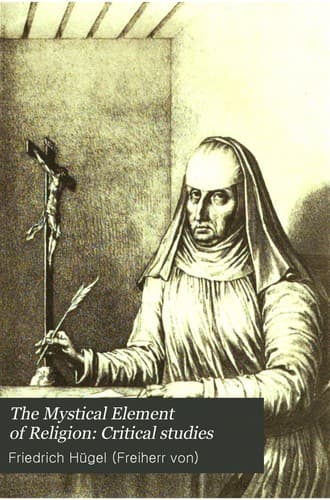
The Mystical Element of Religion, as studied in Saint Catherine of Genoa and her friends, Volume 2 (of 2)Hügel, Friedrich, Freiherr von
Religion
The Mystical Element of Religion, as studied in Saint Catherine of Genoa and her friends, Volume 2 (of 2)
Hügel, Friedrich, Freiherr von
Catherine, of Genoa, Saint, 1447-1510
And lower down we find: “Those who have committed crimes which,
although great, are not unpardonable,--for these it is necessary to
plunge (ἐμπεσεῖν) into Tartarus, the pains of which they are compelled
to undergo for a year; but at the end of the year they are borne to
the Acherusian lake. But those who appear incurable by reason of the
greatness of their crimes … such their appropriate destiny hurls
(ῤίπτει) into Tartarus, whence they never come forth.” Here we get a
Purgatory, pictured as a watery substance in which the more gravely
impure of the curable souls are immersed before arriving at the easier
purification, the waiting on the dry land alongside the lake; this
Purgatory is, as a “place” and, in intensity, identical with Hell; and
into this place the curable souls “plunge” and the incurable ones are
“hurled.”--Of this third passage Catherine retains the identification
of the pains of Purgatory and those of Hell; the “plunge,” or
“hurling,” of two distinct classes of souls into these pains; and
the mitigation, after a time, previous to complete cessation, of the
suffering in the case of the curable class. But the “plunge,” with her,
is common to all degrees of imperfectly pure souls; there is, for all
these souls, no change of “place” during their purgation, but only a
mitigation of suffering; and this mitigation is at work gradually and
from the first. And the ordinary modern Purgatorial teaching is like
this passage, in that it keeps the curable souls in Tartarus, say, for
one year, and lets them suffer there, apparently without mitigation,
throughout that time: and that, in the case of both classes of souls,
it conceives the punishment as extrinsic, vindictive, and inoperative.
And a fourth _Phaedo_ passage tells us: “Those who are remarkable for
having led holy lives are released from this earthly prison, and go
to their pure home, which is above, and dwell in the purer earth,”
the Isles of the Just, in Oceanus. “And those, again, amongst these
who have duly purified themselves with philosophy, live henceforth
altogether without the body, in mansions fairer far than these.” Here
we get, alongside of the two Purgatories and the one Hell, two Heavens,
of which the first is but taken over from Homer and Pindar, but of
which the second is Plato’s own conception. Catherine, in entire accord
with the ordinary teaching, has got but one “place” of each kind; and
her Heaven corresponds, apart from his formal and final exclusion of
every sort of body, to the second of these Platonic Heavens; whilst,
here again, the all-encompassing presence of God’s love for souls as
of the soul’s love for God, which, in her teaching, is the beginning,
means, and end of the whole movement, effects an indefinite difference
between the two positions.[209]
Public-domain text, read in full here on John Shaqi.
Reviews
Reviews
No reviews yet
Be the first to share your thoughts on this work.
Elsewhere in the archive
Join the Discussion
Join the discussion
Sign in to leave a comment or review.
Sign InorCreate an account