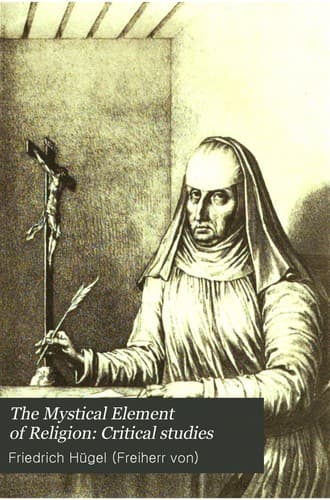
The Mystical Element of Religion, as studied in Saint Catherine of Genoa and her friends, Volume 2 (of 2)Hügel, Friedrich, Freiherr von
Religion
The Mystical Element of Religion, as studied in Saint Catherine of Genoa and her friends, Volume 2 (of 2)
Hügel, Friedrich, Freiherr von
Catherine, of Genoa, Saint, 1447-1510
(3) Yet Plato, in his most characteristic moods, explicitly anticipates
Catherine as to the intrinsic, ameliorative nature and work of
Purgatory: “The proper office of punishment is two-fold: he who
is rightly punished ought either to become better … by it, or he
ought to be made an example to his fellows, that they may see what
he suffers and … become better. Those who are punished by Gods and
men and improved, are those whose sins are curable … by pain and
suffering:--for there is no other way in which they can be delivered
from evil, as in this world so also in the other. But the others are
incurable--the time has passed at which they can receive any benefit
themselves.… Rhadamanthus,” the chief of the three nether-world judges,
“looks with admiration on the soul of some just one, who has lived in
holiness and truth … and sends him” without any intervening suffering
“to the Isles of the Blessed.… I consider how I shall present my soul
whole and undefiled before the Judge, in that day.”[210] Here the last
sentence is strikingly like in form as well as in spirit to many a
saying of St. Paul and Catherine.
(4) But the following most original passages give us a sentiment and an
image which, in their special drift, are as opposed to St. Paul, and
indeed to the ordinary Christian consciousness, as they are dear to
Catherine, in this matter so strongly, although probably unconsciously,
Platonist, indeed Neo-Platonist, in her affinities. “In the time of
Kronos, indeed down to that of Zeus, the Judgment was given on the day
on which men were to die,” _i.e._ immediately _before_ their death;
“and the consequence was, that the judgments were not well given,--the
souls found their way to the wrong places. Zeus said: ‘The reason is,
that the judged have their clothes on, for they are alive.… There are
many, having evil souls, who are apparelled in fair bodies or wrapt
round in wealth and rank.… The Judges are awed by them; and they
themselves too have their clothes on when judging: their eyes and
ears and their whole bodies are interposed, as a veil, before their
own souls. What is to be done? … Men shall be entirely stript before
they are judged, for they shall be judged when dead; the Judge too
shall be naked, that is, dead: he, with his naked soul, shall pierce
into the other naked soul immediately _after_ each man dies … and is
bereft of all his kith and kin, and has left behind him all his brave
attire upon earth, and thus the Judgment will be just.’”[211]--If we
compare this with St. Paul’s precisely contrary instinct and desire to
be “clothed upon” at death, “lest we be found naked,” i.e. without the
protection of any kind of body; and then realize Catherine’s intense
longing for “nudità,”--to strip herself here, as far as possible, from
all imperfection and self-delusion before the final stripping off of
the body in death, and to appear, utterly naked, before the utterly
naked eye of God, so that no “clothes” should remain requiring to
Public-domain text, read in full here on John Shaqi.
Reviews
Reviews
No reviews yet
Be the first to share your thoughts on this work.
Elsewhere in the archive
Join the Discussion
Join the discussion
Sign in to leave a comment or review.
Sign InorCreate an account