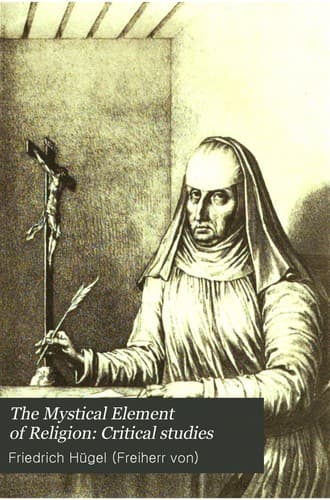
The Mystical Element of Religion, as studied in Saint Catherine of Genoa and her friends, Volume 2 (of 2)Hügel, Friedrich, Freiherr von
Religion
The Mystical Element of Religion, as studied in Saint Catherine of Genoa and her friends, Volume 2 (of 2)
Hügel, Friedrich, Freiherr von
Catherine, of Genoa, Saint, 1447-1510
And again, the term was long synonymous with untruthfulness and deceit.
But here again Prof. Janet shows how unfounded is this prejudice, since
it but springs from the misplaced promptitude with which the earlier
observers refused to believe what they had not as yet sufficiently
examined and could not at all explain, and from the malady being itself
equivalent to a more or less extensive breaking-up of the normal
inter-connection between the several, successive or simultaneous
states, and, as it were, layers of the one personality. He is convinced
that real untruthfulness is no commoner among such patients than it is
among healthy persons.[27]
And, finally, it is no doubt felt that, apart from all such
specifically moral suspicions, the malady involves all kinds of fancies
and inaccuracies of feeling and of perception, and that it frequently
passes into downright insanity. And this is no doubt the one objection
which does retain some of its old cogency. Still, it is well to note
that, as has now been fully established, the elements of the human mind
are and remain the same throughout the whole range of its conditions,
from the sanest to the maddest, whilst only their proportion and
admixture, and the presence or absence and the kind of synthesis
necessary to hold them together differentiate these various states of
mind. In true insanity there is no such synthesis; in hysteria the
synthesis, however slight and peculiar, is always still traceable
throughout the widespread disgregation of the elements and states.[28]
And it is this very persistence of the fundamental unity, together with
the strikingly different combination and considerable disaggregation
of its elements, that makes the study of hysteria so fruitful for
the knowledge of the fully healthy mind and of its unity; whilst the
continuance of all the elements of the normal intelligence, even in
insanity, readily explains why it is apparently so easy to see insanity
everywhere, and to treat genius and sanctity as but so much degeneracy.
2. _Hysteriform phenomena observable in Catherine’s case._
The second group of facts consists in the phenomena which, in
Catherine’s case, are like or identical to what is observable in cases
of hysteria.
There is, perhaps above all else, the anaesthetic condition, which was
presumably co-extensive with her paralytic states. “Anaesthesia,” says
Prof. Janet, “can be considered as the type of the other symptoms of
hysteria; it exists in the great majority of cases, it is thoroughly
characteristic of the malady. In its most frequent localization
(semi-anaesthesia) it affects one of the lateral halves of the body,
and this half is usually the left side.” Or, “a finger or hand will be
affected.” Such “insensibility can be very frequent and very profound”;
but “it disappears suddenly” and even “varies from one moment to
another.”[29]
Public-domain text, read in full here on John Shaqi.
Reviews
Reviews
No reviews yet
Be the first to share your thoughts on this work.
Join the Discussion
Join the discussion
Sign in to leave a comment or review.
Sign InorCreate an account