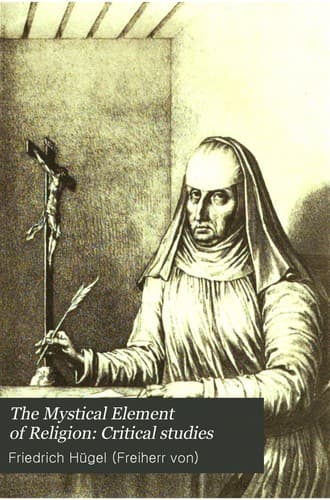
The Mystical Element of Religion, as studied in Saint Catherine of Genoa and her friends, Volume 2 (of 2)Hügel, Friedrich, Freiherr von
Religion
The Mystical Element of Religion, as studied in Saint Catherine of Genoa and her friends, Volume 2 (of 2)
Hügel, Friedrich, Freiherr von
Catherine, of Genoa, Saint, 1447-1510
But it is St. Thomas Aquinas who, by the explicit and consistent
adoption and classification of these _promptuaria receptacula_, reveals
to us more clearly the perplexities and fancifulnesses involved in
the strictly spacial conception. “Although bodies are not assigned
to souls (immediately) after death, yet certain bodily places are
congruously assigned to these souls in accordance with the degree of
their dignity, in which places they are, as it were, locally, in the
manner in which bodiless things can be in space: each soul having a
higher place assigned to it, according as it approaches more or less
to the first substance, God, whose seat, according to Scripture, is
Heaven.” “In the Scriptures God is called the Sun, since He is the
principle of spiritual life, as the physical sun is of bodily life;
and, according to this convention, … souls spiritually illuminated have
a greater fitness for luminous bodies, and sin-darkened souls for dark
places.” “It is probable that, as to local position, Hell and the Limbo
of the Fathers constitute one and the same place, or are more or less
continuous.” “The place of Purgatory adjoins (that of) Hell.” “There
are altogether five places ready to receive (_receptanda_) souls bereft
of their bodies: Paradise, the Limbo of the Fathers, Purgatory, Hell,
and the Limbo of Infants.”[222]
No doubt all these positions became the common scholastic teaching. But
then, as Cardinal Bellarmine cogently points out: “no ancient, as far
as I know, has written that the Earthly Paradise was destroyed … and I
have read a large number who affirm its existence. This is the doctrine
of all the Scholastics, beginning with St. Thomas, and of the Fathers.
… St. Augustine indeed appears to rank this truth amongst the dogmas
of faith.”[223] We shall do well, then, not to press these literal
localization-schemes, especially since, according to St. Augustine’s
penetrating analysis, our spiritual experiences, already in this our
earthly existence, have a distinctly non-spacial character. Catherine’s
position, if applied to the central life of man here, and hence
presumptively hereafter, remains as true and fresh and unassailable as
ever.
(3) And her last simplification consists in taking the Fire of Hell,
the Fire of Purgatory, and the Fire and Light of Heaven as profoundly
appropriate symbols or descriptions of the variously painful or joyous
impressions produced, through the differing volitional attitudes of
souls towards Him, by the one God’s intrinsically identical presence
in each and all. In all three cases, throughout their several grades,
there are ever but two realities, the Spirit-God and the spirit-soul,
in various states of inter-relation.
Public-domain text, read in full here on John Shaqi.
Reviews
Reviews
No reviews yet
Be the first to share your thoughts on this work.
Elsewhere in the archive
Join the Discussion
Join the discussion
Sign in to leave a comment or review.
Sign InorCreate an account