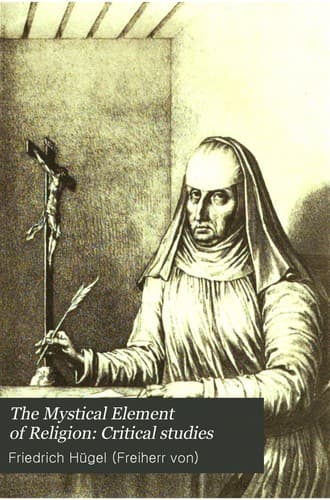
The Mystical Element of Religion, as studied in Saint Catherine of Genoa and her friends, Volume 2 (of 2)Hügel, Friedrich, Freiherr von
Religion
The Mystical Element of Religion, as studied in Saint Catherine of Genoa and her friends, Volume 2 (of 2)
Hügel, Friedrich, Freiherr von
Catherine, of Genoa, Saint, 1447-1510
Here again it is Catherine’s complete abstraction from the body which
renders such a view easy and, in a manner, necessary for her mind. But
here I would only emphasize the impressive simplicity and spirituality
of view which thus, as in the material world it finds the one sun-light
and the one fire-heat, which, in themselves everywhere the same, vary
indefinitely in their effects, owing to the varying condition of the
different bodies which meet the rays and flames; so, in the Spiritual
World it discovers One supreme spiritual Energy and Influence which,
whilst ever self-identical, is assimilated, deflected, or resisted by
the lesser spirits, with inevitably joyous, mixed, or painful states
of soul, since they can each and all resist, but cannot eradicate that
Energy’s impression within their deepest selves. And though, even with
her, the Sun-light image remains quasi-Hellenic and Intellectual, and
the Fire-heat picture is more immediately Christian and Moral: yet
she also frequently takes the sunlight as the symbol of the achieved
Harmony and Peace, and the Fire-heat as that of more or less persisting
Conflict and Pain. She is doubtless right in keeping both symbols, and
in ever thinking of each as ultimately implying the other, for God is
Beauty and Truth, as well as Goodness and Love, and man is made with
the indestructible aspiration after Him in His living completeness.
And here again Catherine has a complicated doctrinal history behind her.
We have already considered the numerous Scriptural passages where
God and His effects upon the soul are symbolized as light and fire;
and those again where joy or, contrariwise, trial and suffering are
respectively pictured by the same physical properties. And Catherine
takes the latter passages as directly explanatory of the first, in
so far as these joys and sufferings are spiritual in their causes or
effects.
Among the Greek Fathers, Clement of Alexandria tells us that “the Fire”
of Purgatory,--for he has no Eternal Damnation,--“is a rational,”
spiritual, “fire that penetrates the soul”; and Origen teaches that
“each sinner himself lights the flame of his own fire, and is not
thrown into a fire that has been lit before that moment and that exists
in front of him.… His conscience is agitated and pierced by its own
pricks.” Saints Gregory of Nyssa and Gregory of Nazianzum are more or
less influenced by Origen on this point. And St. John Damascene, who
died in about 750 A.D., says explicitly that the fire of Hell is not a
material fire, that it is very different from our ordinary fire, and
that men hardly know what it is.[224]
Public-domain text, read in full here on John Shaqi.
Reviews
Reviews
No reviews yet
Be the first to share your thoughts on this work.
Elsewhere in the archive
Join the Discussion
Join the discussion
Sign in to leave a comment or review.
Sign InorCreate an account