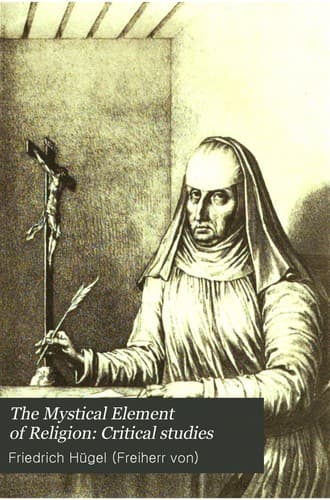
The Mystical Element of Religion, as studied in Saint Catherine of Genoa and her friends, Volume 2 (of 2)Hügel, Friedrich, Freiherr von
Religion
The Mystical Element of Religion, as studied in Saint Catherine of Genoa and her friends, Volume 2 (of 2)
Hügel, Friedrich, Freiherr von
Catherine, of Genoa, Saint, 1447-1510
Taking now the three great after-life conditions separately, in the
order of Hell, Purgatory, and Heaven, I would first of all note that
some readers may be disappointed that Catherine did not, like our
own English Mystic, the entirely orthodox optimist, Mother Juliana
of Norwich--her _Revelations_ belong to the year 1373 A.D.--simply
proclaim that, whilst the teaching and meaning of Christ and His
Church would come true, all, in ways known to God alone, would yet
be well.[232] In this manner, without any weakening of traditional
teaching, the whole dread secret as to the future of evil-doers is
left in the hands of God, and a beautifully boundless trust and hope
glows throughout those contemplations.
Yet, as I hope to show as we go along, certain assumptions and
conceptions, involved in the doctrine of Eternal Punishment, cannot
be systematically excluded, or even simply ignored, without a grave
weakening of the specifically Christian earnestness; and that,
grand as is, in certain respects, the idea of the Apocatastasis,
the Final Restitution of all Things and Souls--as taught by Clement
and Origen--it is not, at bottom, compatible with the whole drift,
philosophy, and tone, (even apart from specific sayings) of Our Lord.
And this latter teaching--of the simply abiding significance and effect
of our deliberate elections during this our one testing-time,--and
not that of an indefinite series of chances and purifications with
an ultimate disappearance of all difference between the results of
the worst life and the best, answers to the deepest postulates and
aspirations of the most complete and delicate ethical and spiritual
sense. For minds that can discriminate between shifting fashions and
solid growth in abiding truth, that will patiently seek out the deepest
instinct and simplest implications underlying the popular presentations
of the Doctrine of Abiding Consequences, and that take these
implications as but part of a larger whole: this doctrine still, and
now again, presents itself as a permanent element of the full religious
consciousness.
It would certainly be unfair to press Catherine’s rare and incidental
sayings on Hell into a formal system. Yet those remarks are deep and
suggestive, and help too much to interpret, supplement, and balance
her central, Purgatorial teaching, and indeed to elucidate her general
religious principles, for us to be able to pass them over. We have
already sufficiently considered the question as to the nature of the
Fire; and that as to Evil Spirits is reserved for the next Chapter.
Here I shall consider four doctrines and difficulties, together with
Catherine’s attitude towards them: the soul’s final fate, dependent
upon the character of the will’s act or active disposition at the
moment of the body’s death; the total moral perversion of the lost; the
mitigation of their pains; and the eternity of their punishment.
1. _Eternity dependent on the earthly life’s last moment._
Public-domain text, read in full here on John Shaqi.
Reviews
Reviews
No reviews yet
Be the first to share your thoughts on this work.
Elsewhere in the archive
Join the Discussion
Join the discussion
Sign in to leave a comment or review.
Sign InorCreate an account