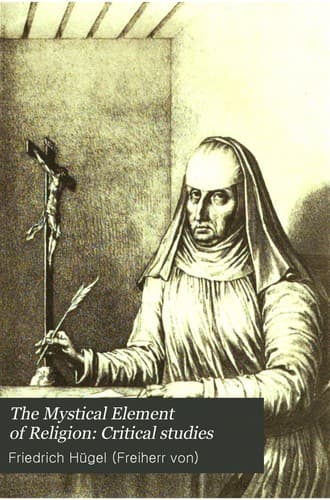
The Mystical Element of Religion, as studied in Saint Catherine of Genoa and her friends, Volume 2 (of 2)Hügel, Friedrich, Freiherr von
Religion
The Mystical Element of Religion, as studied in Saint Catherine of Genoa and her friends, Volume 2 (of 2)
Hügel, Friedrich, Freiherr von
Catherine, of Genoa, Saint, 1447-1510
Now as to the soul’s final fate being made dependent upon the
character of that soul’s particular act or disposition at the last
moment previous to death, this teaching, prominent in parts of the
_Trattato and Vita_, goes back ultimately to Ezekiel, who, as Prof.
Charles interestingly shows, introduces a double individualism into
the older, Social and Organic, Eschatology of the Hebrew Prophets.
For Man is seen, by him, as responsible for his own acts alone, and
as himself working out separately his own salvation or his own doom;
and this individual man again is looked at, not in his organic unity,
but as repeating himself in a succession of separate religious acts.
The individual act is taken to be a true expression of the whole man
at the moment of its occurrence: and hence, if this act is wicked at
the moment of the advent of the Kingdom, the agent will rightfully be
destroyed; but if it be righteous, he will be preserved.[233]--Now
the profound truth and genuine advance thus proclaimed, who can doubt
them? And yet it is clear that the doctrine here is solidly true, only
if taken as the explicitation and supplement, and even in part as the
corrective, of the previously predominant teaching. Take the Ezekielian
doctrine as complete, even for its own time, or as final over against
the later, the Gospel depth of teaching, (with its union of the social
body and of individual souls, and of the soul’s single acts and of the
general disposition produced by and reacting upon these acts), and you
get an all but solipsistic Individualism and an atomistic Psychology,
and you offend Christianity and Science equally.
It is evident that Catherine, if she can fairly be taxed with what,
if pressed, would, in her doctrine rather than in her life, be an
excessive Individualism, is, in her general teaching and practice,
admirably free from Psychological Atomism; indeed did any soul ever
understand better the profound reality of habits, general dispositions,
tones of mind and feeling and will, as distinct from the single acts
that gradually build them up and that, in return, are encircled and
coloured by them all? Her whole Purgatorial doctrine stands and falls
by this distinction, and this although, with a profound self-knowledge,
she does not hesitate to make the soul express, in one particular act
after death,--that of the Plunge,--an even deeper level of its true
attitude of will and of its moral character than is constituted by
those imperfect habits of the will, habits which it will take so much
suffering and acceptance of suffering gradually to rectify.
Public-domain text, read in full here on John Shaqi.
Reviews
Reviews
No reviews yet
Be the first to share your thoughts on this work.
Elsewhere in the archive
Join the Discussion
Join the discussion
Sign in to leave a comment or review.
Sign InorCreate an account