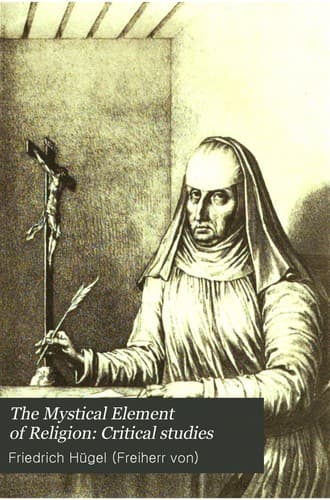
The Mystical Element of Religion, as studied in Saint Catherine of Genoa and her friends, Volume 2 (of 2)Hügel, Friedrich, Freiherr von
Religion
The Mystical Element of Religion, as studied in Saint Catherine of Genoa and her friends, Volume 2 (of 2)
Hügel, Friedrich, Freiherr von
Catherine, of Genoa, Saint, 1447-1510
Thus the passages in which Catherine seems to teach that God can and
does, as it were, catch souls unawares, calling them away, and finally
deciding their fate on occasion of any and every _de facto_ volitional
condition at the instant of death, however little expressive of the
radical determination of that soul such an act or surface-state may be,
will have, (even if they be genuine, and most of them have doubtlessly
grown, perhaps have completely sprung up, under the pen of sermonizing
scribes), to be taken as hortatory, hence as partly hyperbolical.
And such an admission will in nowise deny the possibility for the
soul to express its deliberate and full disposition and determination
in a single act or combination of acts; nor that the other-world
effects will follow according to such deep, deliberate orientations
of the character: it will only deny that, at any and every moment,
any and every act of the soul sufficiently expresses its deliberate
disposition. Certainly it is comparatively rarely that the soul exerts
its full liberty, in an act of true, spiritual self-realization; and
an analogous rarity cannot but be postulated by religious philosophy
for contrary acts, of an approximately equal fulness of deliberation
and accuracy of representation, with regard to the soul’s volitional
state. And yet the operative influence towards such rare, fully
self-expressive acts of the right kind, and the aid towards similar,
massive, and truly representative volitions of the wrong kind, afforded
by even quite ordinary half-awake acts and habits of respectively good
or evil quality are so undeniable, and it is so impossible to draw
a general line as to where such wishes pass into full willings and
deliberate states: that the prevalence of a hortatory attitude towards
the whole subject is right and indeed inevitable.
2. _The reprobate will of the lost._
As to Moral Perversion, the reprobate will of the lost, we find that
Catherine approaches the question from two different, and at bottom,
on this point, incompatible, systems; but some incidental and short
sayings of hers give us suggestive hints towards a consistent position
in this difficult matter.
Public-domain text, read in full here on John Shaqi.
Reviews
Reviews
No reviews yet
Be the first to share your thoughts on this work.
Elsewhere in the archive
Join the Discussion
Join the discussion
Sign in to leave a comment or review.
Sign InorCreate an account