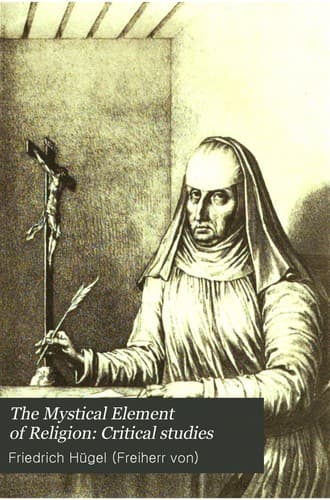
The Mystical Element of Religion, as studied in Saint Catherine of Genoa and her friends, Volume 2 (of 2)Hügel, Friedrich, Freiherr von
Religion
The Mystical Element of Religion, as studied in Saint Catherine of Genoa and her friends, Volume 2 (of 2)
Hügel, Friedrich, Freiherr von
Catherine, of Genoa, Saint, 1447-1510
Now I know that St. Thomas had already taught, in at first sight
identical terms: “Evil cannot exist (quite) pure without the admixture
of good, as the Supreme Good exists free from all admixture of evil.…
Those who are detained in Hell, are not bereft of all good”;[236] and
yet he undoubtedly maintained the complete depravation of the will’s
dispositions in these souls. And, again, after Catherine’s first
declaration there follow, (at least in the text handed down in the
_Vita_), words which explain that extrinsic mercy, not as mitigating
the finite amount of suffering due to the sinner, but as turning the
infinite suffering due to the sinner’s infinite malice, into a finite,
though indefinite amount; and hence, in the second declaration, a
corresponding interior mercy may be signified--God’s grace preventing
the sinner from being infinitely wicked.
But Catherine, unlike St. Thomas, expressly speaks not only of Good and
Evil, but of Good and Malignancy; and Malignancy undoubtedly refers
to dispositions of the will. And even if the words, now found as the
sequel to the first saying, be authentic, they belong to a different
occasion, and cannot be allowed to force the meaning of words spoken
at another time. In this latter saying the words “as it were” show
plainly that she is not thinking of a possible infiniteness of human
wickedness which has been changed, through God’s mercy, to an actual
finitude of evil; but is simply asking herself whether a man could be,
not infinitely but wholly, malignant. For she answers that, were this
possible, a man would “as it were” be as malignant as God is good, and
thus shows that the malignancy, which she denies, would only in a sense
form a counterpart to God’s benevolence: since, though the man would be
as entirely malignant as God is entirely good, God would still remain
infinite in His goodness as against the finitude of Man’s wickedness.
Public-domain text, read in full here on John Shaqi.
Reviews
Reviews
No reviews yet
Be the first to share your thoughts on this work.
Elsewhere in the archive
Join the Discussion
Join the discussion
Sign in to leave a comment or review.
Sign InorCreate an account