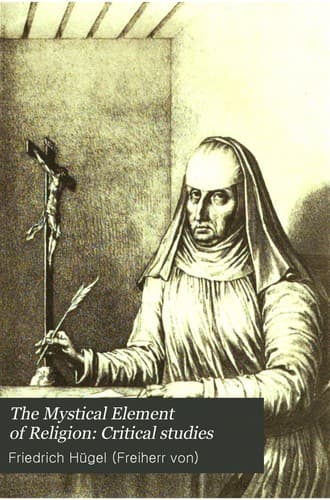
The Mystical Element of Religion, as studied in Saint Catherine of Genoa and her friends, Volume 2 (of 2)Hügel, Friedrich, Freiherr von
Religion
The Mystical Element of Religion, as studied in Saint Catherine of Genoa and her friends, Volume 2 (of 2)
Hügel, Friedrich, Freiherr von
Catherine, of Genoa, Saint, 1447-1510
It is admitted on all hands that, in the practical form of Prayers for
the Dead, the general doctrine of a Middle State can be traced back, in
Judaism, up to the important passage in the Second Book of Maccabees,
c. ii, vv. 43-45, where Judas Maccabaeus sends about two thousand
drachms of silver to Jerusalem, in order that a Sin-Offering may be
offered up for the Jews fallen in battle against Gorgias, upon whose
bodies heathen amulets had been found. “He did excellently in this …
it is a holy and devout thought. Hence he instituted the Sin-Offering
for the dead, that they might be loosed from their sins.” That battle
occurred in B.C. 166, and this book appears to have been written in
B.C. 124, in Egypt, by a Jew of the school of the Pharisees.
Now it is difficult not to recognize, in the doctrinal comment upon the
facts here given, rather as yet the opinions of a Judaeo-Alexandrian
circle, which was small even at the time of the composition of the
comment, than the general opinion of Judaism at the date of Judas’s
act. For if this act had been prompted by a clear and generally
accepted conviction as to the resurrection, and the efficacy of prayers
for the dead, the writer would have had no occasion or inclination to
make an induction of his own as to the meaning and worth of that act;
and we should find some indications of such a doctrine and practice in
the voluminous works of Philo and Josephus, some century and a half
later on. But all such indications are wanting in these writers.
And in the New Testament there is, with regard to helping the dead,
only that curious passage: “If the dead do not arise, what shall they
do who are baptized for the dead?”[253] where St. Paul refers, without
either acceptance or blame, to a contemporary custom among Christian
Proselytes from Paganism, who offered up that bath of initiation for
the benefit of the souls of deceased relatives who had died without any
such purification. Perhaps not till Rabbi Akiba’s time, about 130 A.D.,
had prayers for the dead become part of the regular Synagogue ritual.
By 200 A.D. Tertullian speaks of the practice as of an established
usage among the Christian communities: “we make oblations for the Dead,
on their anniversary, every year”; although “if you ask where is the
law concerning this custom in Scripture, you cannot read of any such
there. Tradition will appear before you as its initiator, custom as its
confirmer, and faith as its observer.”[254]
Public-domain text, read in full here on John Shaqi.
Reviews
Reviews
No reviews yet
Be the first to share your thoughts on this work.
Elsewhere in the archive
Join the Discussion
Join the discussion
Sign in to leave a comment or review.
Sign InorCreate an account