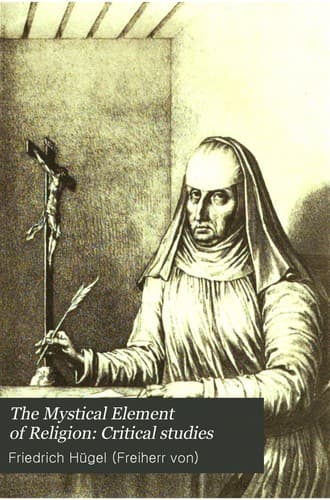
The Mystical Element of Religion, as studied in Saint Catherine of Genoa and her friends, Volume 2 (of 2)Hügel, Friedrich, Freiherr von
Religion
The Mystical Element of Religion, as studied in Saint Catherine of Genoa and her friends, Volume 2 (of 2)
Hügel, Friedrich, Freiherr von
Catherine, of Genoa, Saint, 1447-1510
Indeed the general principle of ameliorative suffering is so obviously
true and inexhaustibly profound that only many, long-lived abuses
in the practice, and a frequent obscuration in the teaching, of the
doctrine, can explain and excuse the sad neglect, indeed discredit,
into which the very principle and root-doctrine has fallen among
well-nigh one-half of Western Christendom. As to the deplorably
widespread existence, at the time of the Protestant Reformation, of
both these causes, which largely occasioned or strengthened each other,
we have the unimpeachable authority of the Council of Trent itself: for
it orders the Bishops “not to permit that uncertain doctrines, or such
as labour under the presumption of falsity, be propagated and taught,”
and “to prohibit, as so many scandals and stones of stumbling for the
faithful, whatever belongs to a certain curiosity or superstition or
savours of filthy lucre.”[251] The cautious admissions of the strictly
Catholic scholar-theologian, Dr. N. Paulus, and the precise documentary
additions and corrections to Paulus furnished, directly from the
contemporary documents, by the fair-minded Protestant worker at
Reformation History, Prof. T. Brieger, now furnish us, conjointly, with
the most vivid and detailed picture of the sad subtleties and abuses
which gave occasion to that Decree.[252]
(3) _Catherine’s purgatorial conceptions avoid those causes. Her
conceptions harbour two currents of thought._
It is surely not a small recommendation of Catherine’s mode of
conceiving Purgatory, that it cuts, as we shall see, at the very root
of those abuses. Yet we must first face certain opposite dangers and
ambiguities which are closely intertwined with the group of terms
and images taken over, for the purpose of describing an immanental
Purgation, by her and her great Alexandrian Christian predecessors,
from the Greek Heathen world. And only after the delimitation of the
defect in the suggestions which still so readily operate from out of
these originally Hellenic ideas, can we consider the difficulties and
imperfections peculiar to the other, in modern times the predominant,
element in the complete teaching as to the Middle State, an element
mostly of Jewish and Roman provenance, and aiming at an extrinsically
punitive conception. Both currents can be properly elucidated only if
we first take them historically.
1. _Jewish prayers for the dead._
Public-domain text, read in full here on John Shaqi.
Reviews
Reviews
No reviews yet
Be the first to share your thoughts on this work.
Elsewhere in the archive
Join the Discussion
Join the discussion
Sign in to leave a comment or review.
Sign InorCreate an account