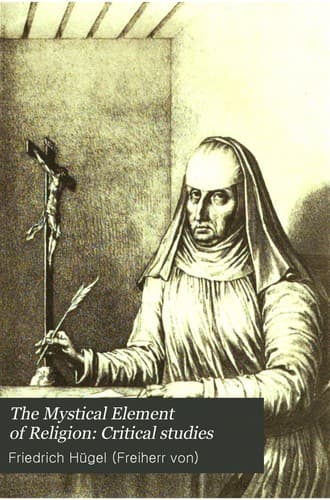
The Mystical Element of Religion, as studied in Saint Catherine of Genoa and her friends, Volume 2 (of 2)Hügel, Friedrich, Freiherr von
Religion
The Mystical Element of Religion, as studied in Saint Catherine of Genoa and her friends, Volume 2 (of 2)
Hügel, Friedrich, Freiherr von
Catherine, of Genoa, Saint, 1447-1510
And this idea, as to an intrinsic purgation through suffering of
impurities contracted by the soul, can be kept thoroughly Christian,
if we ever insist, with Catherine in her most emphatic and deepest
teachings, that Purgation can and should be effected in this life,
hence in the body,--in and through all the right uses of the body,
as well as in and through all the legitimate and will-strengthening
abstentions from such uses; that the subject-matter of such purgation
are the habits and inclinations contrary to our best spiritual lights,
and which we have largely ourselves built up by our variously perverse
or slothful acts, but which in no case are directly caused by the body,
and in many cases are not even occasioned by it; and, finally, that
holiness consists primarily, not in the absence of faults, but in the
presence of spiritual force, in Love creative, Love triumphant,--the
soul becoming flame rather than snow, and dwelling upon what to do,
give and be, rather than upon what to shun.--Catherine’s predominant,
ultimate tone possesses this profound positiveness, and corrects all
but entirely whatever, if taken alone, would appear to render the
soul’s substantial purity impossible in this life; to constitute the
body a direct and necessary cause of impurity to the soul; and to find
the ideal of perfection in the negative condition of being free from
stain. In her greatest sayings, and in her actual life, Purity is
found to be Love, and this Love is exercised, not only in the inward,
home-coming, recollective movement,--in the purifying of the soul’s
dispositions, but also in the outgoing, world-visiting, dispersive
movement,--in action towards fellow-souls.
5. _Judaeo-Roman conception of Purgatory._
And this social side and movement brings us to the second element and
current in the complete doctrine of a Middle State,--a constituent
which possesses affinities and advantages, and produces excesses
and abuses, directly contrary to those proper to the element of an
intrinsic purgation.
Public-domain text, read in full here on John Shaqi.
Reviews
Reviews
No reviews yet
Be the first to share your thoughts on this work.
Elsewhere in the archive
Join the Discussion
Join the discussion
Sign in to leave a comment or review.
Sign InorCreate an account