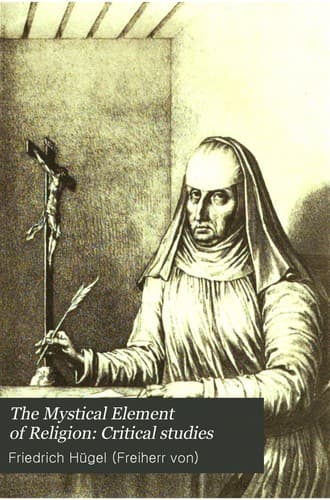
The Mystical Element of Religion, as studied in Saint Catherine of Genoa and her friends, Volume 2 (of 2)Hügel, Friedrich, Freiherr von
Religion
The Mystical Element of Religion, as studied in Saint Catherine of Genoa and her friends, Volume 2 (of 2)
Hügel, Friedrich, Freiherr von
Catherine, of Genoa, Saint, 1447-1510
(1) Here we get early Christian utilizations, for purposes of a
doctrine concerning the Intermediate State, of sayings and images which
dwell directly only upon certain extrinsic consequences of evil-doing,
or which, again, describe a future historical and social event,--the
Last Day. For already Origen interprets, in his beautiful _Treatise on
Prayer_, XXIX, 16, Our Lord’s words as to the debtor: “Thou shalt be
cast into prison, thou shalt not come forth from thence, until thou
hast paid the uttermost farthing,” Matt, v, 25, 26, as applying to
Purgatory. And in his _Contra Celsum_, VII, 13, he already takes, as
the Biblical _locus classicus_ for a Purgatory, St. Paul’s words as to
how men build, upon the one foundation Christ, either gold, silver,
gems, or wood, hay, stubble; and how fire will test each man’s work;
and, if the work remain, he shall receive a reward, but if it be burnt,
he shall suffer loss and yet he himself shall be saved yet so as by
fire, 1 Cor. iii, 10-15. It appears certain, however, that St. Paul
is, in this passage, thinking directly of the Last Day, the End of the
World, with its accompaniment of physical fire, and as to how far the
various human beings, then on earth, will be able to endure the dread
stress and testing of that crisis; and he holds that some will be fit
to bear it and some will not.
Such a destruction of the world by fire appears elsewhere in
Palestinian Jewish literature,--in the Book of Enoch and the Testament
of Levi; and in the New Testament, in 2 Peter iii, 12: “The heavens
being on fire shall be dissolved, the elements shall melt with fervent
heat.” Josephus, _Antiquities_, XI, ii, 3, teaches a destruction by
fire and another by water. And the Stoics, to whom also Clement and
Origen appeal, had gradually modified their first doctrine of a simply
cosmological Ekpyrōsis, a renovation of the physical universe by fire,
into a moral purification of the earth, occasioned by, and applied
to, the sinfulness of man. Thus Seneca has the double, water-and-fire,
instrument: “At that time the tide” of the sea “will be borne along
free from all measure, for the same reason which will cause the future
conflagration. Both occur when it seems fit to God to initiate a better
order of things and to have done with the old.… The judgment of mankind
being concluded, the primitive order of things will be recalled, and to
the earth will be re-given man innocent of crimes.”[266]
Public-domain text, read in full here on John Shaqi.
Reviews
Reviews
No reviews yet
Be the first to share your thoughts on this work.
Elsewhere in the archive
Join the Discussion
Join the discussion
Sign in to leave a comment or review.
Sign InorCreate an account