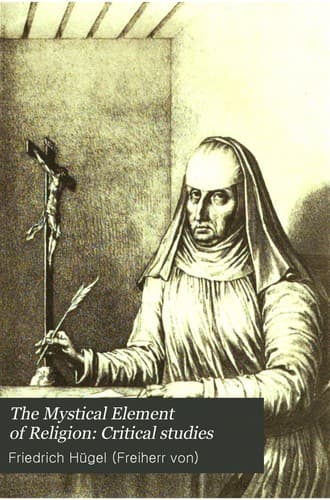
The Mystical Element of Religion, as studied in Saint Catherine of Genoa and her friends, Volume 2 (of 2)Hügel, Friedrich, Freiherr von
Religion
The Mystical Element of Religion, as studied in Saint Catherine of Genoa and her friends, Volume 2 (of 2)
Hügel, Friedrich, Freiherr von
Catherine, of Genoa, Saint, 1447-1510
(3) The position of a purely extrinsic punishment is emphasized, with
even unusual vehemence, in the theological glosses inserted, in about
1512 to 1529, in Catherine’s _Dicchiarazione_. Yet it is probably
the very influential Jesuit theologian Francesco Suarez, who died
in 1617, who has done most towards formulating and theologically
popularizing this view. All the guilt of sin, he teaches, is remitted
(in these Middle souls) at the first moment of the soul’s separation
from the body, by means of a single act of contrition, whereby the
will is wholly converted to God, and turned away from every venial
sin. “And in this way sin may be remitted, as to its guilt, in
Purgatory, because the soul’s purification dates from this moment”;--in
strictness, from before the first moment of what should be here termed
the “Satisfactorium.” As to bad habits and vicious inclinations,
“we ought not to imagine that the soul is detained for these”: but
“they are either taken away at the moment of death, or expelled by an
infusion of the contrary virtues when the soul enters into glory.”[267]
This highly artificial, inorganic view is adopted, amongst other
of our contemporary theologians, by Atzberger, the continuator of
Scheeben.[268]
6. _The Judaeo-Roman conception must be taken in synthesis with the
Alexandrine._
Now it is plain that the long-enduring Penitential system of the Latin
Church, and the doctrine and practice of Indulgences stand for certain
important truths liable to being insufficiently emphasized by the Greek
teachings concerning an intrinsically ameliorative _Purgatorium_, and
that there can be no question of simply eliminating these truths.
But neither are they capable of simple co-ordination with, still
less of super-ordination to, those most profound and spiritually
central immanental positions. As between the primarily forensic and
governmental, and the directly ethical and spiritual, it will be the
former that will have to be conceived and practised as, somehow, an
expression and amplification of, and a practical corrective and means
to, the latter.[269]
(1) The ordinary, indeed the strictly obligatory, Church teaching
clearly marks the suggested relation as the right one, at three, simply
cardinal points. We are bound, by the Confession of Faith of Michael
Palaeologus, 1267 A.D., and by the Decree of the Council of Florence,
1429 A.D., to hold that these Middle souls “are purged after death by
purgatorial or cathartic pains”; and by that of Trent “that there is
a Purgatory.”[270] Yet we have here a true _lucus a non lucendo_, if
this place or state does not involve purgation: for no theologian dares
explicitly to transfer and restrict the name “Purgatory” to the instant
of the soul’s Particular Judgment; even Suarez, as we have seen, has to
extend the name somehow.
Public-domain text, read in full here on John Shaqi.
Reviews
Reviews
No reviews yet
Be the first to share your thoughts on this work.
Elsewhere in the archive
Join the Discussion
Join the discussion
Sign in to leave a comment or review.
Sign InorCreate an account