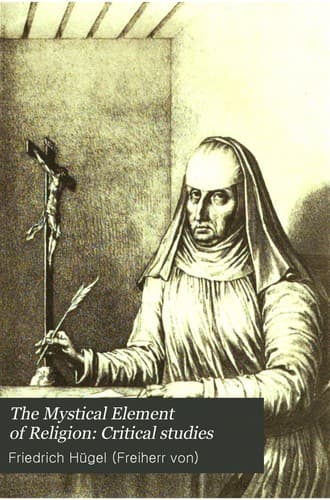
The Mystical Element of Religion, as studied in Saint Catherine of Genoa and her friends, Volume 2 (of 2)Hügel, Friedrich, Freiherr von
Religion
The Mystical Element of Religion, as studied in Saint Catherine of Genoa and her friends, Volume 2 (of 2)
Hügel, Friedrich, Freiherr von
Catherine, of Genoa, Saint, 1447-1510
(2) It is interesting to note how--largely under the influence of the
forensic temper and growth of the Canonical Penitential system, and
of its successive relaxations in the form of substituted lighter good
works, Indulgences,--the Latin half of Christendom, ever more social
and immediately practical than the Greek portion, came, in general,
more and more to dwell upon two ideas suggested to their minds by
those two, Gospel and Pauline, passages. The one idea was that souls
which, whilst fundamentally well-disposed, are not fit for Heaven at
the body’s death, can receive instant purification by the momentary
fire of the Particular Judgment; and the other held that, thus already
entirely purified and interiorly fit for Heaven, they are but detained
(in what we ought, properly, to term a _Satisfactorium_), to suffer
the now completely non-ameliorative, simply vindictive, infliction of
punishment,--a punishment still, in strict justice, due to them for
past sins, of which the guilt and the deteriorating effects upon their
own souls have been fully remitted and cured.
In this way it was felt that the complete unchangeableness of the
condition of every kind of soul after death, or at least after the
Particular Judgment (a Judgment held practically to synchronize with
death), was assured. And indeed how could there be any interior growth
in Purgatory, seeing that there is no meriting there? Again it was
thought that thus the vision of God at the moment of Judgment was given
an operative value for the spiritual amelioration of souls which,
already in substantially good dispositions, could hardly be held to
pass through so profound an experience without intrinsic improvement,
as the other view seemed to hold.--And, above all, this form of the
doctrine was found greatly to favour the multiplication among the
people of prayers, Masses and good-works for the dead; since the _modus
operandi_ of such acts seemed thus to become entirely clear, simple,
immediate, and, as it were, measurable and mechanical. For these souls
in their “Satisfactorium,” being, from its very beginning, already
completely purged and fit for Heaven,--God is, as it were, free to
relax at any instant, in favour of sufficiently fervent or numerous
intercessions, the exigencies of his entirely extrinsic justice.
Public-domain text, read in full here on John Shaqi.
Reviews
Reviews
No reviews yet
Be the first to share your thoughts on this work.
Elsewhere in the archive
Join the Discussion
Join the discussion
Sign in to leave a comment or review.
Sign InorCreate an account