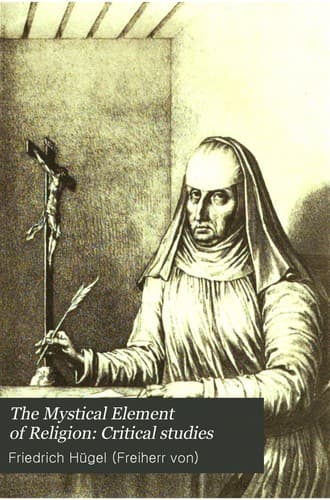
The Mystical Element of Religion, as studied in Saint Catherine of Genoa and her friends, Volume 2 (of 2)Hügel, Friedrich, Freiherr von
Religion
The Mystical Element of Religion, as studied in Saint Catherine of Genoa and her friends, Volume 2 (of 2)
Hügel, Friedrich, Freiherr von
Catherine, of Genoa, Saint, 1447-1510
St. Thomas declares most plainly: “Venial guilt, in a soul which
dies in a state of grace, is remitted after this life by the purging
fire, because that pain, which is in some manner accepted by the
will, has, in virtue of grace, the power of expiating all such guilt
as can co-exist with a state of grace.” “After this life … there can
be merit with respect to some accidental reward, so long as a man
remains in some manner in a state of probation: and hence there can be
meritorious acts in Purgatory, with respect to the remission of venial
sin.”[277]--Dante (_d._ 1321) also appears, as Father Faber finely
notes, to hold such a voluntary, immanental Purgatory, where the poet
sees an Angel impelling, across the sea at dawn, a bark filled with
souls bent for Purgatory: for the boat is described as driving towards
the shore so lightly as to draw no wake upon the water.[278]
Cardinal Bellarmine, perhaps the greatest of all anti-Protestant
theologians (_d._ 1621) teaches that “venial sin is remitted in
Purgatory _quoad culpam_,” and that “this guilt, as St. Thomas rightly
insists, is remitted in Purgatory by an act of love and patient
endurance.”[279] St. Francis of Sales, that high ascetical authority
(_d._ 1622), declares: “By Purgatory we understand a place where souls
undergo purgation, for a while, from the stains and imperfections which
they have carried away with them from this mortal life.”[280]
And recently and in England we have had Father Faber, Cardinal Manning,
and Cardinal Newman, although differing from each other on many other
points, fully united in holding and propagating this finely life-like,
purgative conception of purgatory.[281]
7. _A final difficulty._
One final point concerning a Middle State. In the Synoptic tradition
there is a recurrent insistence upon the forgiveness of particular
sins, at particular moments, by particular human and divine acts of
contrition and pardon. In the Purgatorial teaching the stress lies
upon entire states and habits, stains and perversities of soul, and
upon God’s general grace working, in and through immanently necessary,
freely accepted sufferings, on to a slow purification of the complete
personality. As Origen says: “The soul’s single acts, good or bad, go
by; but, according to their quality, they give form and figure to to
the mind of the agent, and leave it either good or bad, and destined
for pains or for rewards.”[282]
Public-domain text, read in full here on John Shaqi.
Reviews
Reviews
No reviews yet
Be the first to share your thoughts on this work.
Elsewhere in the archive
Join the Discussion
Join the discussion
Sign in to leave a comment or review.
Sign InorCreate an account