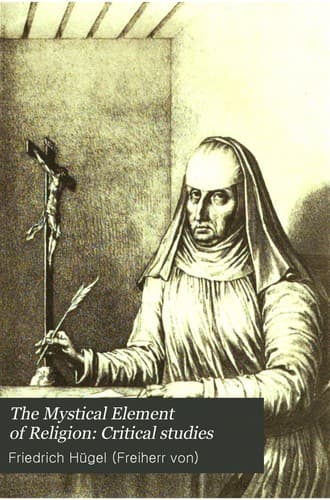
The Mystical Element of Religion, as studied in Saint Catherine of Genoa and her friends, Volume 2 (of 2)Hügel, Friedrich, Freiherr von
Religion
The Mystical Element of Religion, as studied in Saint Catherine of Genoa and her friends, Volume 2 (of 2)
Hügel, Friedrich, Freiherr von
Catherine, of Genoa, Saint, 1447-1510
Our first question, then, is as to the probable character of man’s
happiest ultimate consciousness,--whether it is one of succession or
of simultaneity: in other words, whether, besides the disappearance of
the category of space (a point already discussed), there is likely to
be the lapse of the category of time also.--And let it be noted that
the retention of the latter sense for Hell, and even for Purgatory,
does not prejudge the question as to its presence or absence in Heaven,
since those two states are admittedly non-normative, whereas the latter
represents the very ideal and measure of man’s full destination and
perfection.
(1) Now it is still usual, amongst those who abandon the ultimacy
of the space-category, simultaneously to drop, as necessarily
concomitant, the time-category also. Tennyson, among the poets, does
so, in his beautiful “Crossing the Bar”: “From out our bourne of Time
and Place, the flood may bear me far”; and Prof. H. J. Holtzmann,
among speculative theologians, in criticising Rothe’s conception of
man as a quite ultimately spacial-temporal being, treats these two
questions as standing and falling together.[283]--Yet a careful study
of Kant’s critique of the two categories of Space and Time suffices
to convince us of the indefinitely richer content, and more ultimate
reality, of the latter. Indeed, I shall attempt to show more fully in
the next Chapter, with the aid of M. Henri Bergson, that mathematical,
uniform clock-time is indeed an artificial compound, which is made up
of our profound experience of a duration in which the constituents
(sensations, imaginations, thoughts, feelings, willings) of the
succession ever, in varying degrees, overlap, interpenetrate, and
modify each other, and the quite automatic and necessary simplification
and misrepresentation of this experience by its imaginary projection on
to space,--its restatement, by our picturing faculty, as a perfectly
equable succession of mutually exclusive moments. It is in that
interpenetrative duration, not in this atomistic clock-time, that our
deeper human experiences take place.
(2) But that sense of duration, is it indeed our deepest apprehension?
Dr. Holtzmann points out finely how that we are well aware, in our
profoundest experiences, of “that permanently incomprehensible
fact,--the existence of, as it were, a prism, through which the
unitary ray of light, which fills our consciousness with a real
content, is spread out into a colour-spectrum, so that what, in itself,
exists in pure unitedness” and simultaneity, “becomes intelligible to
us only as a juxtaposition in space and a succession in time. Beyond
the prism, there are no such two things.” And he shows how keenly
conscious we are, at times, of that deepest mode of apprehension and
of being which is a Simultaneity, an eternal Here and Now; and how
ruinous to our spiritual life would be a full triumph of the category
of time.[284]
Public-domain text, read in full here on John Shaqi.
Reviews
Reviews
No reviews yet
Be the first to share your thoughts on this work.
Elsewhere in the archive
Join the Discussion
Join the discussion
Sign in to leave a comment or review.
Sign InorCreate an account