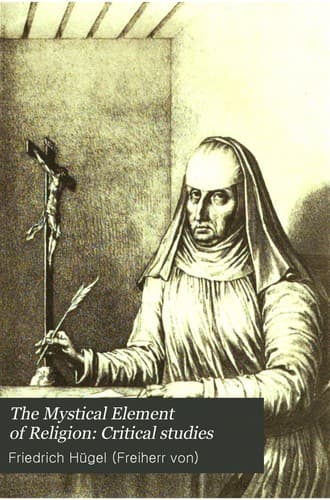
The Mystical Element of Religion, as studied in Saint Catherine of Genoa and her friends, Volume 2 (of 2)Hügel, Friedrich, Freiherr von
Religion
The Mystical Element of Religion, as studied in Saint Catherine of Genoa and her friends, Volume 2 (of 2)
Hügel, Friedrich, Freiherr von
Catherine, of Genoa, Saint, 1447-1510
But it is St. Augustine who has, so far, found the noblest expression
for the deepest human experiences in this whole matter of Duration and
Simultaneity, as against mere Clock-Time, although, here as with regard
to Space, he is deeply indebted to Plotinus. “In thee, O my soul, I
measure time,--I measure the impression which passing events make
upon thee, who remainest when those events have passed: this present
impression then, and not those events which had to pass in order to
produce it, do I measure, when I measure time.” “The three times,”
tenses, “past, present, and future … are certain three affections in
the soul, I find them there and nowhere else. There is the present
memory of past events, the present perception of present ones, and the
present expectation of future ones.” God possesses “the splendour of
ever-tarrying Eternity,” which is “incomparable with never-tarrying
times,” since in it “nothing passes, but the content of everything
abides simply present.” And in the next life “perhaps our own thoughts
also will not be flowing, going from one thing to another, but we shall
see all we know simultaneously, in one intuition.” St. Thomas indeed is
more positive: “All things will,” in Heaven, “be seen simultaneously
and not successively.”[285]
(3) If then, even here below, we can so clearly demonstrate the
conventionality of mere Clock-Time, and can even conceive a perfect
Simultaneity as the sole form of the consciousness of God, we cannot
well avoid holding that, in the other life, the clock-time convention
will completely cease, and that, though the sense of Duration is
not likely completely to disappear, (since, in this life at least,
this sense is certainly not merely phenomenal for man, and its
entire absence would apparently make man into God), the category of
Simultaneity will, as a sort of strong background-consciousness,
englobe and profoundly unify the sense of Duration. And, the more
God-like the soul, the more would this sense of Simultaneity
predominate over the sense of Duration.
2. _The Ultimate Good, concrete, not abstract._
Our second question concerns the kind and degree of variety in unity
which we should conceive to characterize the life of God, and of the
soul in its God-likeness. Is this type and measure of all life to be
conceived as a maximum of abstraction or as a maximum of concretion;
as pure thought alone, or as also emotion and will; as solitary and
self-centred, or as social and outgoing; and as simply reproductive, or
also as operative?
(1) Now it is certain that nothing is easier, and nothing has been
more common, than to take the limitations of our earthly conditions,
and especially those attendant upon the strictly contemplative, and,
still more, those connected with the technically ecstatic states, as so
many advantages, or even as furnishing a complete scheme of the soul’s
ultimate life.
Public-domain text, read in full here on John Shaqi.
Reviews
Reviews
No reviews yet
Be the first to share your thoughts on this work.
Elsewhere in the archive
Join the Discussion
Join the discussion
Sign in to leave a comment or review.
Sign InorCreate an account