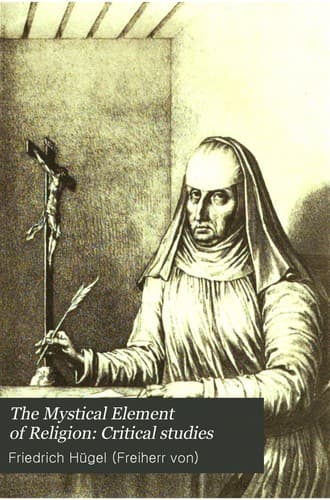
The Mystical Element of Religion, as studied in Saint Catherine of Genoa and her friends, Volume 2 (of 2)Hügel, Friedrich, Freiherr von
Religion
The Mystical Element of Religion, as studied in Saint Catherine of Genoa and her friends, Volume 2 (of 2)
Hügel, Friedrich, Freiherr von
Catherine, of Genoa, Saint, 1447-1510
(i) Aristotle here introduces the mischief. For it is he who in his
great, simply immeasurably influential, theological tractate, Chapters
VI to X of the Twelfth Book of his _Metaphysic_, has presented to us
God as “the one first unmoved Mover” of the Universe, but Who moves it
as desired by it, not as desiring it, as outside of it, not as also
inside it. God here is sheer Pure Thought, Noēsis, for “contemplation
is the most joyful and the best” of actions. And “Thought” here
“thinks the divinest and worthiest, without change,” hence “It thinks
Itself, and the Thinking is a Thinking of Thought.”[289] We have here,
as Dr. Caird strikingly puts it, a God necessarily shut up within
Himself, “of purer eyes than to behold, not only iniquity but even
contingency and finitude, and His whole activity is one act of pure
self-contemplation.” “The ideal activity which connects God with the
world, appears thus as in the world and not in God.”[290]
(ii) Now we have already allowed that the Mystics avoid Aristotle’s
elimination of emotion from man’s deepest action, and of emotion’s
equivalent from the life of God. But they are, for the most part, much
influenced in their speculations by this intensely Greek, aristocratic,
intellectualist conception, in the three points of a disdain of the
Contingent and Historical; of a superiority to volitional, productive
energizing; and of a presentation of God as unsocial, and as occupied
directly with Himself alone. We have already studied numerous examples
of the first two, deeply un-Christian, errors as they have more or
less influenced Christian Mysticism; the third mistake, of a purely
Transcendental, Deistic God, is indeed never consistently maintained
by any Christian, and Catherine, in particular, is ever dominated by
the contrary great doctrine, adumbrated by Plato and fully revealed by
Our Lord, of the impulse to give Itself intrinsic to Goodness, so that
God, as Supreme Goodness, becomes the Supreme Self-giver, and thus the
direct example and motive for our own self-donation to Him. Yet even
so deeply religious a non-Christian as Plotinus, and such speculative
thinkers as Eriugena and Eckhart (who certainly intended to remain
Christians) continue all three mistakes, and especially insist upon a
Supreme Being, Whose true centre, His Godhead, is out of all relation
to anything but Himself. And even the orthodox Scholastics, and St.
Thomas himself, attempt at times to combine, with the noblest Platonic
and the deepest Christian teachings, certain elements, which, in
strictness, have no place in an Incarnational Religion.
Public-domain text, read in full here on John Shaqi.
Reviews
Reviews
No reviews yet
Be the first to share your thoughts on this work.
Elsewhere in the archive
Join the Discussion
Join the discussion
Sign in to leave a comment or review.
Sign InorCreate an account