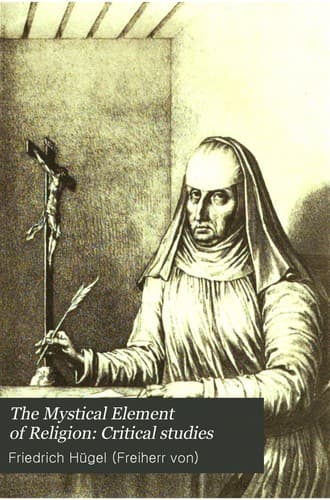
The Mystical Element of Religion, as studied in Saint Catherine of Genoa and her friends, Volume 2 (of 2)Hügel, Friedrich, Freiherr von
Religion
The Mystical Element of Religion, as studied in Saint Catherine of Genoa and her friends, Volume 2 (of 2)
Hügel, Friedrich, Freiherr von
Catherine, of Genoa, Saint, 1447-1510
The first contribution can, indeed, be credited to Aristotle, whose
luminous formulations concerning Energeia, Action, (as excluding
Motion, or Activity), we have already referred to. Here to _be_ is
to _act_, and Energeia, a being’s perfect functioning and fullest
self-expression in action, is not some kind of movement or process;
but, on the contrary, all movement and process is only an imperfect
kind of Energeia. Man, in his life here, only catches brief glimpses of
such an Action; but God is not so hampered,--He is ever completely all
that He can be, His Action is kept up inexhaustibly and ever generates
supreme bliss; it is an unchanging, unmoving Energeia.[286]--And St.
Thomas echoes this great doctrine, for all the Christian schoolmen: “A
thing is declared to be perfect, in proportion as it is in act,”--as
all its potentialities are expressed in action; and hence “the First
Principle must be supremely in act,” “God’s Actuality is identical with
His Potentiality,” “God is Pure Action (_Actus Purus_).”[287]--Yet it
is doubtless the Christian Mystics who have most fully experienced, and
emotionally vivified, this great truth, and who cease not, in all their
more characteristic teachings, from insisting upon the ever-increasing
acquisition of “Action,” the fully fruitful, peaceful functioning of
the whole soul, at the expense of “activity,” the restless, sterile
distraction and internecine conflict of its powers. And Heaven, for
them, ever consists in an unbroken Action, devoid of all “activity,”
rendering the soul, in its degree, like to that Purest Action, God,
who, Himself “Life,” is, as our Lord declared, “not the God of the dead
but of the living.”[288]
And the second contribution can, in part, be traced back to Plato,
who does not weary, in the great middle period of his writings, from
insisting upon the greatness of the nobler passions, and who already
apprehends a Heavenly Eros which in part conflicts with, in part
transcends, the Earthly one. But here especially it is Christianity,
and in particular Christian Mysticism, which have fully experienced
and proclaimed that “God” is “Love,” and that the greatest of all the
soul’s acts and virtues is Charity, Pure Love. And hence the Pure
Act of God, and the Action of the God-like soul, are conceived not,
Aristotle-like, as acts of pure intelligence alone, but as tinged
through and through with a noble emotion.
(3) But in three matters the Mystics, as such and as a whole, have,
here especially under the predominant influence of Greek thought,
remained inadequate to the great spiritual realities, as most fully
revealed to us by Christianity. The three points are so closely
interconnected that it will be best first to illustrate, and then to
criticise them, together.
Public-domain text, read in full here on John Shaqi.
Reviews
Reviews
No reviews yet
Be the first to share your thoughts on this work.
Elsewhere in the archive
Join the Discussion
Join the discussion
Sign in to leave a comment or review.
Sign InorCreate an account