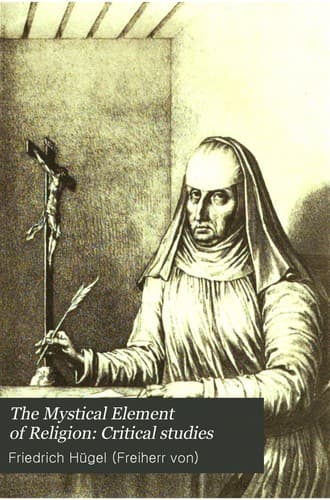
The Mystical Element of Religion, as studied in Saint Catherine of Genoa and her friends, Volume 2 (of 2)Hügel, Friedrich, Freiherr von
Religion
The Mystical Element of Religion, as studied in Saint Catherine of Genoa and her friends, Volume 2 (of 2)
Hügel, Friedrich, Freiherr von
Catherine, of Genoa, Saint, 1447-1510
(iv) And yet St. Thomas’s own deeply Christian sense, explicit sayings
of Our Lord or of St. Paul, and even, in part, certain of the fuller
apprehensions of the Greeks, can make the great Dominican again
uncertain, or can bring him to entirely satisfactory declarations,
on each of these points. For we get the declaration that direct
knowledge of individual things, and quasi-creative operativeness are
essential to all true perfection. “To understand something merely
in general and not in particular, is to know it imperfectly”; Our
Lord Himself has taught us that “the very hairs of your head are all
numbered”; hence God must “know all other individual things with
a distinct and proper knowledge.”--And “a thing is most perfect,
when it can make another like unto itself. But by tending to its
own perfection, each thing tends to become more and more like God.
Hence everything tends to be like God, in so far as it tends to be
the cause of other things.”[295]--We get a full insistence, with St.
Paul, (in I Cor. xiii), upon our love of God, an act of the will,
as nobler than our cognition of Him; and with Plato and St. John,
upon God’s forthgoing Love for His creatures, as the very crown and
measure of His perfection. “Everything in nature has, as regards its
own good, a certain inclination to diffuse itself amongst others, as
far as possible. And this applies, in a supreme degree, to the Divine
Goodness, from which all perfection is derived.” “Love, Joy, Delight
can be predicated of God”; Love which, of its very essence “causes
the lover to bear himself to the beloved as to his own self”: so that
we must say with Dionysius that “He, the very Cause of all things,
becomes ecstatic, moves out of Himself, by the abundance of His loving
goodness, in the providence exercised by Him towards all things
extant.”[296]
(v) And we get in St. Thomas, when he is too much dominated by the
abstractive trend, a most interesting, because logically necessitated
and quite unconscious, collision with certain sayings of Our Lord. For
he then explains Matt. xviii, 10, “their,” the children’s, “Angels
see without ceasing the face of their Father who is in Heaven” as
teaching that “the action (_operatio_), by which Angels are conjoined
to the increate Good, is, in them, unique and sempiternal”; whereas his
commentators are driven to admit that the text, contrariwise, implies
that these Angels have two simultaneous “operations,” and that their
succouring action in nowise disturbs their intellectual contemplation.
Hence, even if we press Matt. xxii, 30, that we “shall be as the Angels
of God,” we still have an organism of peaceful Action, composed of
intellectual, affective, volitional, productive acts operating between
the soul and God, and the soul and other souls, each constituent and
object working and attained in and through all the others.
Public-domain text, read in full here on John Shaqi.
Reviews
Reviews
No reviews yet
Be the first to share your thoughts on this work.
Elsewhere in the archive
Join the Discussion
Join the discussion
Sign in to leave a comment or review.
Sign InorCreate an account