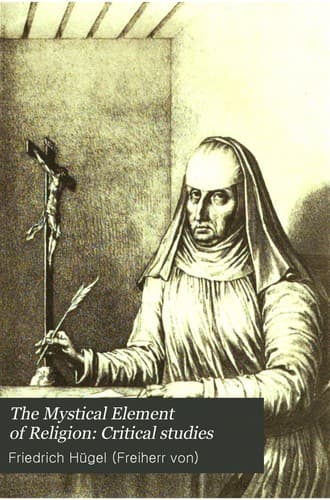
The Mystical Element of Religion, as studied in Saint Catherine of Genoa and her friends, Volume 2 (of 2)Hügel, Friedrich, Freiherr von
Religion
The Mystical Element of Religion, as studied in Saint Catherine of Genoa and her friends, Volume 2 (of 2)
Hügel, Friedrich, Freiherr von
Catherine, of Genoa, Saint, 1447-1510
(vi) Indeed all Our Lord’s Synoptic teachings, as to man’s ultimate
standard and destiny, belong to this God-in-man and man-in-God type
of doctrine: for there the two great commandments are strictly
inseparable; God’s interest in the world is direct and detailed,--it
is part of His supreme greatness that He cares for every sparrow that
falls to the ground; and man, in the Kingdom of God, will sit down
at a banquet, the unmistakable type of social joys.--And even the
Apocalypse, which has, upon the whole, helped on so much the conception
of an exclusive, unproductive entrancement of each soul singly in
God alone, shows the deepest emotion when picturing all the souls,
from countless tribes and nations, standing before the throne,--an
emotion which can, surely, not be taken as foreign to those souls
themselves.[297] But, indeed, Our Lord’s whole life and message become
unintelligible, and the Church loses its deepest roots, unless the
Kingdom of God is, for us human souls, as truly a part of our ultimate
destiny as is God Himself, that God who fully reveals to us His own
deepest nature as the Good Shepherd, the lover of each single sheep and
of the flock as a whole.[298]
(4) We shall, then, do well to hold that the soul’s ultimate beatitude
will consist in its own greatest possible self-realization in its
God-likeness,--an Action free from all Activity, but full of a knowing,
feeling, willing, receiving, giving, effectuating, all which will
energize between God and the soul, and the soul and other souls,--each
force and element functioning in its proper place, but each stimulated
to its fullest expansion, and hence to its deepest delight, by the
corresponding vitalization of the other powers and ends, and of other
similar centres of rich action.
3. _The pain-element of Bliss._
And our third, last question is whether our deepest this-life
apprehensions and experiences give us any reason for holding that a
certain equivalent for what is noblest in devoted suffering, heroic
self-oblivion, patient persistence in lonely willing, will be present
in the life of the Blessed. It would certainly be a gain could we
discover such an equivalent, for a pure glut of happiness, an unbroken
state of sheer enjoyment, can as little be made attractive to our most
spiritual requirements, as the ideal of an action containing an element
of, or equivalent for, devoted and fruitful effort and renunciation can
lose its perennial fascination for what is most Christian within us.
Public-domain text, read in full here on John Shaqi.
Reviews
Reviews
No reviews yet
Be the first to share your thoughts on this work.
Elsewhere in the archive
Join the Discussion
Join the discussion
Sign in to leave a comment or review.
Sign InorCreate an account