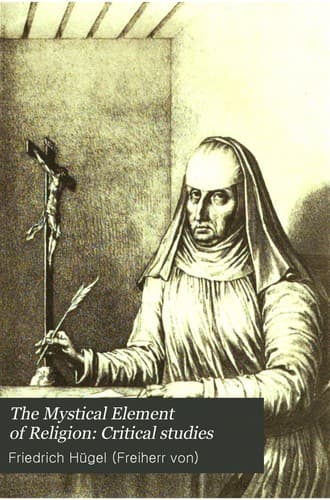
The Mystical Element of Religion, as studied in Saint Catherine of Genoa and her friends, Volume 2 (of 2)Hügel, Friedrich, Freiherr von
Religion
The Mystical Element of Religion, as studied in Saint Catherine of Genoa and her friends, Volume 2 (of 2)
Hügel, Friedrich, Freiherr von
Catherine, of Genoa, Saint, 1447-1510
unrest can indeed give way to clear sight and certitude: yet this very
clarity and assurance will, in each human soul, still bear a certain
individual character,” fully comprehensible to the other souls by love
land trust alone.[303]
(3) And this same element we find, of course, in a still greater
degree,--although, as I shall argue later on, our experimental
knowledge of God is greater than is our knowledge of our
fellow-creatures,--in the relations between our love of God and our
knowledge of Him. St. Thomas tells us most solidly: “Individual
Being applies to God, in so far as it implies Incommunicableness.”
Indeed, “_Person_ signifies the most perfect thing in nature,”--“the
subsistence of an individual in a rational nature.” “And since the
dignity of the divine nature exceeds every other dignity, this name
of Person is applicable, in a supreme degree, to God.” And again:
“God, as infinite, cannot be held infinitely by anything finite “;
and hence “only in the sense in which comprehension is opposed to
a seeking after Him, is God comprehended, _i.e._ possessed, by the
Blessed.” And hence the texts: “I follow, if that I may apprehend,
seeing that I also am apprehended” (Phil. iii, 12); “then shall I
know even as I am known” (1 Cor. xiii, 12); and “we shall see Him as
He is” (1 John iii, 2): all refer to such a possession of God. In the
last text “the adverb ‘as’ only signifies ‘we shall see His essence’
and not ‘we shall have as perfect a mode of vision as God has a mode
of being.’”[304]--Here again, then, we find that souls loving God in
His Infinite Individuality, will necessarily love Him beyond their
intellectual comprehension of Him; the element of devoted trust, of
free self-donation to One fully known only through and in such an act,
will thus remain to man for ever. St. John of the Cross proclaimed this
great truth: “One of the greatest favours of God, bestowed transiently
upon the soul in this life, is its ability to see so distinctly, and
to feel so profoundly, that … it cannot comprehend Him at all. These
souls are herein, in some degree, like to the souls in heaven, where
they who know Him most perfectly perceive most clearly that He is
infinitely incomprehensible; for those that have the less clear vision,
do not perceive so distinctly as the others how greatly He transcends
their vision.”[305] With this teaching, so consonant with Catherine’s
experimental method, and her continuous trust in the persistence of the
deepest relations of the soul to God, of the self-identical soul to the
unchanging God, we can conclude this study of her Eschatology.
CHAPTER XIII
THE FIRST THREE ULTIMATE QUESTIONS. THE RELATIONS BETWEEN MORALITY,
MYSTICISM, PHILOSOPHY, AND RELIGION. MYSTICISM AND THE LIMITS OF HUMAN
EXPERIENCE AND KNOWLEDGE. MYSTICISM AND THE NATURE OF EVIL
Public-domain text, read in full here on John Shaqi.
Reviews
Reviews
No reviews yet
Be the first to share your thoughts on this work.
Elsewhere in the archive
Join the Discussion
Join the discussion
Sign in to leave a comment or review.
Sign InorCreate an account