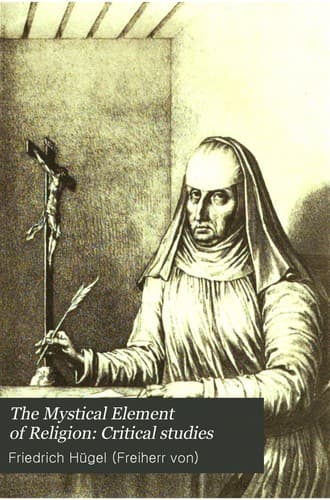
The Mystical Element of Religion, as studied in Saint Catherine of Genoa and her friends, Volume 2 (of 2)Hügel, Friedrich, Freiherr von
Religion
The Mystical Element of Religion, as studied in Saint Catherine of Genoa and her friends, Volume 2 (of 2)
Hügel, Friedrich, Freiherr von
Catherine, of Genoa, Saint, 1447-1510
I take the ultimate questions involved in the religious positions
which are taken up by Catherine, and indeed by the Christian Mystics
generally, and which we have studied in the preceding two chapters,
to be four. In the order of their increasing difficulty they are: the
question as to the relations between Morality, Mysticism, Philosophy,
and Religion; that as to the Limits of Human Knowledge, and as to the
special character and worth of the Mystics’ claim to Trans-subjective
Cognition; that as to the Nature of Evil and the Goodness or Badness
of Human Nature; and that as to Personality,--the character of, and
the relations between, the human spirit and the Divine Spirit. The
consideration of these deepest matters in the next two chapters will, I
hope, in spite of its inevitable element of dimness and of repetition,
do much towards binding together and clarifying the convictions which
we have been slowly acquiring,--ever, in part, with a reference to
these coming ultimate alternatives and choices.
I. THE RELATIONS BETWEEN MORALITY AND MYSTICISM PHILOSOPHY AND RELIGION.
Now the first of these questions has not, for most of the more
strenuous of our educated contemporaries, become, so far again, a
living question at all. A morally good and pure, a socially useful and
active life,--all this in the sense and with the range attributed to
these terms by ordinary parlance: this and this alone is, for doubtless
the predominant public present-day consciousness, the true object,
end, and measure of all healthy religion; whatever is alongside of,
or beyond, or other than, or anything but a direct and exclusive
incentive to this, is so much superstition and fanaticism. According to
this view, at least one half of Catherine’s activity at all times, and
well-nigh the whole of it during her last period, would be practically
worthless. Thus only certain elements of such a life would be retained
even for and in religion, and even these would be bereft of all that
has hitherto been held to be their specifically religious sense and
setting.
1. _Kant’s non-mystical religion._
Public-domain text, read in full here on John Shaqi.
Reviews
Reviews
No reviews yet
Be the first to share your thoughts on this work.
Elsewhere in the archive
Join the Discussion
Join the discussion
Sign in to leave a comment or review.
Sign InorCreate an account