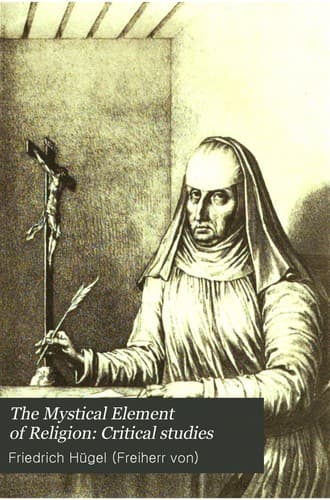
The Mystical Element of Religion, as studied in Saint Catherine of Genoa and her friends, Volume 2 (of 2)Hügel, Friedrich, Freiherr von
Religion
The Mystical Element of Religion, as studied in Saint Catherine of Genoa and her friends, Volume 2 (of 2)
Hügel, Friedrich, Freiherr von
Catherine, of Genoa, Saint, 1447-1510
reproduce in himself; indeed religion, of this type, he readily rejects
as fanaticism. Here lay the limit both of his own nature and of his own
times.”[307]
The rich mind of Prof. Troeltsch is, perhaps, more entirely just: “As
Kant’s theory of knowledge is throughout dependent upon the state of
contemporary psychology, so also is his theory of religious knowledge
dependent upon the psychology of religion predominant in his day.
Locke, Leibniz, Pascal had already recognized the essentially practical
character of all religion; and since their psychology was unable to
conceive the ‘practical’ otherwise than as the moral, it had looked
upon Religion as Morality furnished forth with its metaphysical
concomitants. And as soon as this psychology had become the very
backbone of his conception of Religion, Morality gained an entirely
one-sided predominance over Kant’s mind,--considerably, indeed, beyond
his own personal feelings and perceptions.” For he remains deeply
penetrated by “the conceptions of Regeneration and Redemption; the idea
of divine Grace and Wisdom, which accepts the totality of a soul’s
good disposition in lieu of that soul’s ever defective single good
works; the belief in a Providence which strengthens the Good throughout
the world against Evil; adoring awe in face of the majesty of the
Supersensible”: and “all these” conceptions “are no more simply moral,
they are specifically religious thoughts.”[308]
Such a fuller conception of religion is admirably insisted on by that
penetrating philosopher and historian of philosophy, Prof. Windelband:
“Actual Religion, in its complete reality, belongs to all the spheres
of life, and yet transcends them all, as something new and _sui
generis_. It is first an interior life--an apprehending, cognizing,
feeling, willing, accomplishing. But this accomplishing leads it on to
being also an exterior life: an acting out, according to their various
standards, of such feeling and willing; and an outward expression of
that inner life in general, in ritual acts and divine worship. Yet
this worship takes it beyond the little circle of the individual, and
constitutes the corporate acts of a community, a social, external
organization with visible institutions. And yet Religion ever claims to
be more than the whole series of such empirical facts and doings, it
ever transcends mere earthly experience, and is an intercourse with the
inmost nature and foundation of all reality; it is a life in and with
God, a metaphysical life. All these elements belong to the complete
concept of actual religion.”[309] I would add, that they each stimulate
the other, the external, _e.g._ being not only the expression of the
awakened internal, but also the occasion of that awakening.
Public-domain text, read in full here on John Shaqi.
Reviews
Reviews
No reviews yet
Be the first to share your thoughts on this work.
Elsewhere in the archive
Join the Discussion
Join the discussion
Sign in to leave a comment or review.
Sign InorCreate an account