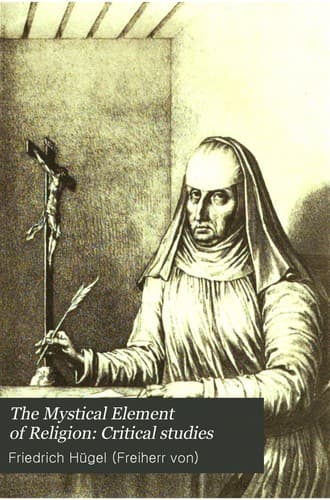
The Mystical Element of Religion, as studied in Saint Catherine of Genoa and her friends, Volume 2 (of 2)Hügel, Friedrich, Freiherr von
Religion
The Mystical Element of Religion, as studied in Saint Catherine of Genoa and her friends, Volume 2 (of 2)
Hügel, Friedrich, Freiherr von
Catherine, of Genoa, Saint, 1447-1510
It is doubtless Kant who, among the philosophers, has been the most
consistent and influential in inculcating such non-Mystical Religion.
“Religion,” he says in 1793, “is, on its subjective side, the cognition
of all our duties as so many Divine Commandments.” “The delusion that
we can effect something, in view of our justification before God, by
means of acts of religious worship, is religious superstition; and
the delusion that we can effect something by attempts at a supposed
intercourse with God, is religious fanaticism.… Such a feeling of the
immediate presence of the Supreme Being, and such a discrimination
between this feeling and every other, even moral, feeling, would
imply a capacity for an intuition, which is without any corresponding
organ in human nature.… If then a Church doctrine is to abolish or
to prevent all religious delusion, it must,--over and above its
statutory teachings, with which it cannot, for the present, entirely
dispense,--contain within itself a principle which shall enable it to
bring about the religion of a pure life, as the true end of the whole
movement, and then to dispense with those temporary doctrines.”[306]
It is deeply instructive to note how thoroughly this, at first sight,
solid and triumphant view, has not only continued to be refuted by the
actual practice and experience of specifically religious souls, but how
explicitly it is being discredited by precisely the more delicately
perceptive, the more truly detached and comprehensive, students and
philosophers of religion of the present day,--heirs, let us not forget
in justice to Kant, of the intervening profound development of the
historical sense, and of the history and psychology of religion.--Thus
that most vigorous, independent thinker, Prof. Simmel of Berlin,
writes in 1904: “Kant has, I think, simply passed by the essentials
of religion,--that is to say, of that reality which historically bears
the name of religion. Only the reflection, that the harmony of complete
happiness with complete morality is producible by a Divine Being
alone, is here supposed to lead us to believe in such a Being. There
is here a complete absence of that direct laying hold of the Divine
by our souls, because of our intrinsic needs, which characterizes
all genuine piety. And the religious sense is not recognized as an
organism with a unity of its own, as a growth springing from its own
root. The entirely specific character of religion, which is resolvable
neither into morality nor into a thirst after happiness: the direct
self-surrender of the soul to a higher reality, the giving and taking,
the unification and differentiation,--that quite organic unity of the
religious experience, which we can but most imperfectly indicate by
a multiplicity of some such, simultaneously valid, antitheses: this,
there is no evidence to show, was ever really known to Kant. What
was religion for Augustine and Francis of Assisi, he was unable to
Public-domain text, read in full here on John Shaqi.
Reviews
Reviews
No reviews yet
Be the first to share your thoughts on this work.
Elsewhere in the archive
Join the Discussion
Join the discussion
Sign in to leave a comment or review.
Sign InorCreate an account